

Market Review
Equity markets continued to climb the wall of worry in the third quarter as investors weighed mixed economic data, conflicting news around trade deals and tariff impacts, ongoing momentum in the AI theme, and a rate cut by the Federal Reserve. Despite a weakening labor market and still elevated inflation, consumer activity was strong in the third quarter, helping to support investor risk appetite. Both U.S. and international markets reached new all-time highs in the third quarter, while small caps, now positive for the year, rebounded strongly on optimism about rate cuts and hopes for stimulus from the One Big Beautiful Bill Act (OBBBA). Strength in emerging markets continued last quarter, pushing that beleaguered segment of the global equity market to gains of almost 28% in 2025 (Exhibit 1).
Exhibit 1: Major Stock Market Indices Returns 3Q 2025
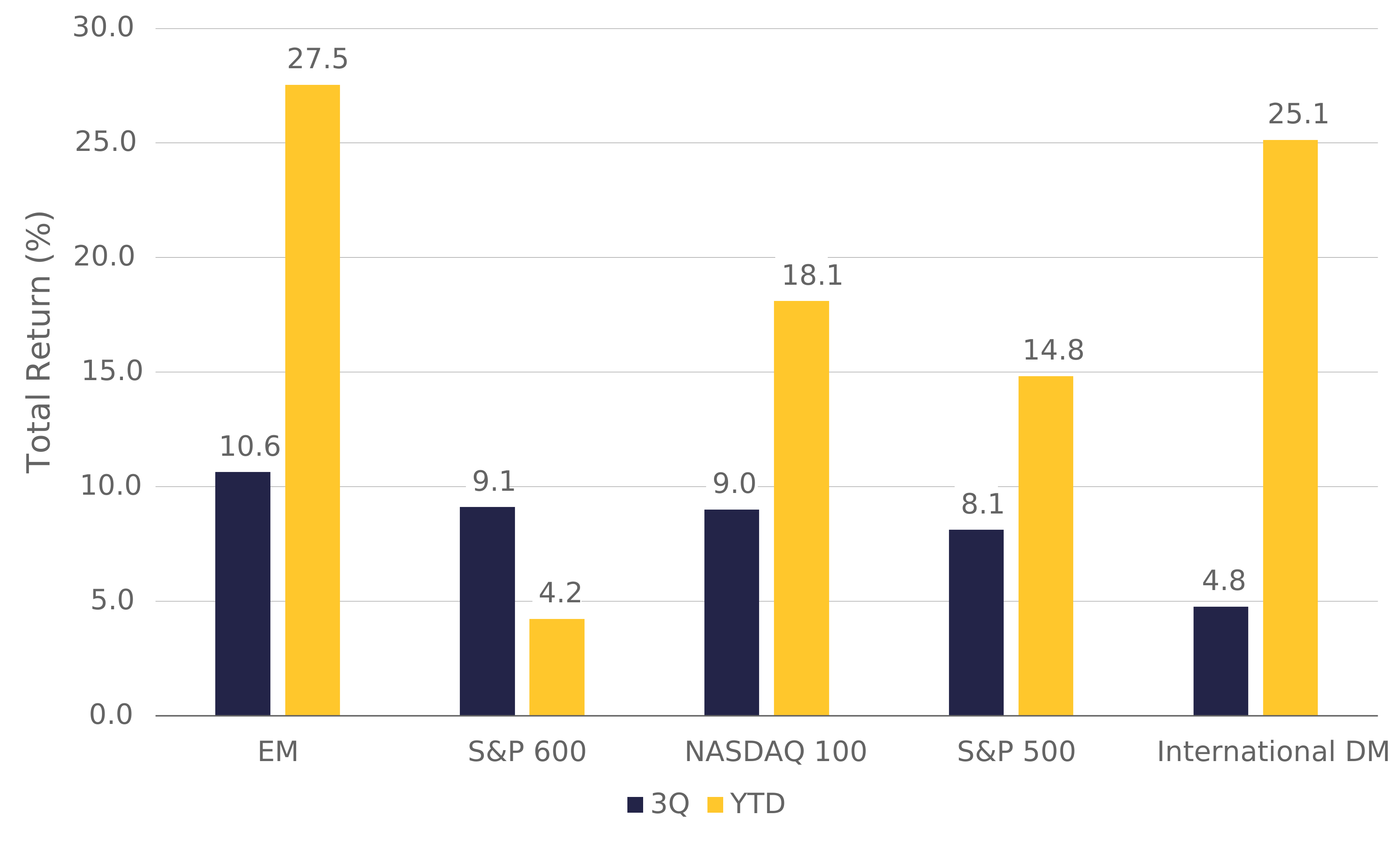
Bloomberg, data as of 09/30/2025. Emerging Markets (EM) are represented by the MSCI Emerging Markets Index. International Developed Markets (DM) are represented by the MSCI EAFA Index. Past performance is not indicative of future results. Indices are unmanaged and do not have fees or expense charges, both of which would lower returns. It is not possible to invest directly in an index. Please see attached disclosures.
The Fed delivered a 25 basis point cut to its target rate, matching investor expectations, in mid-September. Despite this cut and the weaker tone to the labor market data, benchmark Treasury yields fell only modestly in the third quarter. Credit markets remained strong, underpinned by elevated nominal growth and healthy corporate fundamentals. The dollar rebounded slightly from its steep losses in the first half of the year, while gold rallied almost 17% in the third quarter to record highs in both nominal and inflation-adjusted terms.

Horizon’s Gain models maintained their fully invested stance across equities and fixed income during the third quarter, adjusting to changing investor expectations around growth and economic policy while continuing to track the evolving mega-theme of Artificial Intelligence (AI). On the equity side, the quarter began with a slight overweight position in international markets, focused exposure to the AI theme in the U.S., and reduced exposure to broad domestic value compared to earlier in the year. In the first half of the quarter, strong earnings, AI-related deal flow, and lower interest rates drove high-beta equities to outperform defensives. As a result, we deferred adding exposure to the top of the domestic market until investor positioning normalized in early September. Domestic banks were consistently overweight in the Gain equity portfolio during the third quarter, and this tilt was further enhanced through a focused holding of regionals as part of the reallocation made late in the quarter. This trade also increased the portfolio’s expected market capture versus global stocks in both the domestic and international portions of the portfolio in order to position for a market rally into year end.
The fixed income portfolio of the Gain models experienced more modest movements than the equity portfolio in the third quarter. As fears over the labor market rose throughout the quarter, long-term bond yields fell, and the market pulled forward expectations for Fed easing. Despite its modestly shorter duration profile and positioning in diversifying market segments, such as Treasury Inflation-Protected Securities (TIPS) and international bonds, the Gain fixed income portfolio kept pace with the strong rally in core bonds in the third quarter through its credit overweight and positioning in actively managed holdings in structured credit and mortgage-backed securities. The 10 year yield touched its lowest level since the Liberation Day market volatility in early April, ahead of the Fed meeting in mid-September. Viewing this as an overreaction to noisy and volatile economic data, the team further shortened the interest rate sensitivity of the portfolio by selling long-term U.S. Treasuries in favor of a higher-yielding mid-curve holding. Interest rates rose modestly into the end of the quarter after the Fed cut its target rate by the expected 25 basis points.
Equity Contributors and Detractors
Domestic large-cap growth, broad international developed markets, and emerging markets contributed the most to equity portfolio performance in the third quarter. In contrast, a focused European allocation, international small-cap value, and domestic regional banks contributed the least.
Fixed Income Contributors and Detractors
Domestic large-cap growth, broad international developed markets, and emerging markets contributed the most to equity portfolio performance in the third quarter. In contrast, a focused European allocation, international small-cap value, and domestic regional banks contributed the least.

Horizon’s Protect models were fully exposed to their underlying equity and fixed income allocations in the third quarter as markets added to this year’s gains. With the Risk Assist® algorithm in its default “off” position, the Protect portfolios were better able to participate in the market rally. Furthermore, all models ratchetted during the quarter, establishing new levels for measuring future portfolio drawdowns.
The tactical tilts in the Protect equity allocation followed Horizon’s standard portfolio construction process in the third quarter, mirroring the moves in the Gain equity portfolio with broader positioning and a slight defensive bias. The quarter began with a modest overweight to international markets versus global stocks, a tilt in favor of domestic large-cap growth, and an average allocation to defensive market segments. The magnitude of the move in high beta versus defensive equities in the first half of the quarter, fueled by strong earnings and deal flow in the AI space, as well as lower interest rates, led us to delay adding to the top of the domestic market until investor positioning became more balanced in early September. The quarter’s one reallocation raised the equity portfolio’s exposure to domestic growth at the expense of value, increasing the expected market capture versus global stocks in order to position for a market rally into year-end.
The fixed income component of the Protect portfolios followed the activity of the Gain portfolios during the quarter. Investor anxiety over the state of the labor market rose throughout the quarter, causing long-term bond yields to fall as the market pulled forward expectations for Fed easing. Despite its modestly shorter duration profile and positioning in diversifying market segments such as TIPS and international bonds, the Protect fixed income portfolio kept pace with the strong rally in core bonds in the third quarter through its credit overweight and positioning in actively managed holdings in structured credit and mortgage-backed securities. The 10 year yield touched its lowest level since the Liberation Day market volatility in early April, ahead of the Fed meeting in mid-September. The team viewed this move as an overreaction to noisy and volatile economic data, and used the opportunity to further shorten the interest rate sensitivity of the portfolio by selling long-term U.S. Treasuries in favor of a higher-yielding mid-curve holding. As the quarter came to a close, interest rates rose modestly after the Fed delivered on expectations by cutting its target rate by 25 basis points.
Equity Contributors and Detractors
Domestic large-cap growth, emerging markets, and international developed markets led performance in the Protect equity portfolio during the third quarter. In contrast, domestic large-cap quality, domestic equal-weight large-caps, and domestic low volatility were the weakest contributors.
Fixed Income Contributors and Detractors
Intermediate-term investment-grade corporate credit, an actively managed higher-yielding strategy, and long-term investment-grade corporates contributed the most to fixed-income performance last quarter. Newly-issued mortgage-backed securities, long-term U.S. Treasuries, and currency-hedged international bonds contributed the least to returns in the third quarter.

As a result of the positive market environment for both stocks and bonds in the third quarter, Horizon’s Spend strategies were fully exposed to their long-term target growth allocations. The Risk Assist® algorithm was also in its default “off” position, allowing the Spend models to participate more in the third-quarter market rally. The Spend portfolios followed Horizon’s standard rebalancing process at the end of the quarter, replenishing the spending reserve back to a full 12 quarters of spend.
While the narrow equity market environment proved a headwind to the more diversified, dividend-tilted Spend equity portfolio, the outperformance of stocks versus fixed income provided a tailwind to the core portfolio tilt of Horizon’s retirement suite. Outside of the standard liquidity reserve rebalancing, the Spend models saw very modest allocation adjustments across equities and fixed income in the third quarter. The equity portion of the Spend models aligns with global equities in terms of domestic versus international exposure and features tilts toward lower volatility and higher dividend stocks in the domestic portion of the portfolio. The fixed income stance remains moderately risk-on, expressed through an underweight to Treasuries and the utilization of active management in higher yielding parts of the market.
Contributors and Detractors
Domestic large-cap growth and broad international developed markets drove performance in the Spend equity portfolio last quarter. Allocations to domestic mid-caps and domestic low volatility contributed the least to performance in the third quarter.
In the Spend models’ fixed-income portfolio, long-term investment-grade corporate bonds led performance last quarter, while U.S. Treasuries contributed the least.
Market Outlook
As we close the books on the third quarter and look ahead to the final three months of the year, it is striking how similar the current market set-up feels to what we saw last September. Then as now, investors are concerned about the slowdown in the labor market, leading to lower long-term bond yields and a reduction in the Fed’s short-term interest rate. Policymakers in China are also once again contemplating stimulus to try to kickstart economic growth in the second largest economy in the world. Meanwhile, the AI theme, still concentrated primarily in domestic large-caps, is propelling equity indices higher even as investors debate the payback in terms of company earnings from this massive investment boom. Political uncertainty remains a hot topic of conversation as well, although investors today are focused more on actual government policies and tariffs impacts rather than trying to handicap the results of a coming election. Our top macro focuses remain the labor market and actual consumer behavior, with trade policies and the extent of the Fed’s cutting cycle as background developments that may increase in importance over time. Earnings season, set to kick off in mid-October, will provide helpful data to add to our macro views, especially on the topics of the outlook for profit margins, labor demand, and AI deployment. In summary, we remain optimistic in our expectations for how markets and the economy will evolve into the end of the year. If the outlook darkens in the months ahead, Horizon stands ready to deploy our risk management techniques to help you empower your clients to tune out the noise and focus on their long-term financial objectives.