Rising debt costs in the AI space are raising eyebrows
You’re likely aware that many technology companies are spending epic sums of money on AI these days. Take tech titans like Oracle, Alphabet, Microsoft, Amazon, and Meta that are building out massive data centers and other infrastructure to power AI. These so-called hyperscalers are on pace to invest more than $750 billion in AI this year—an amount equal to more than 2% of the U.S.’s entire annual gross domestic product.
That AI-focused spending tsunami is changing the tech landscape in ways that investors may want to pay attention to.
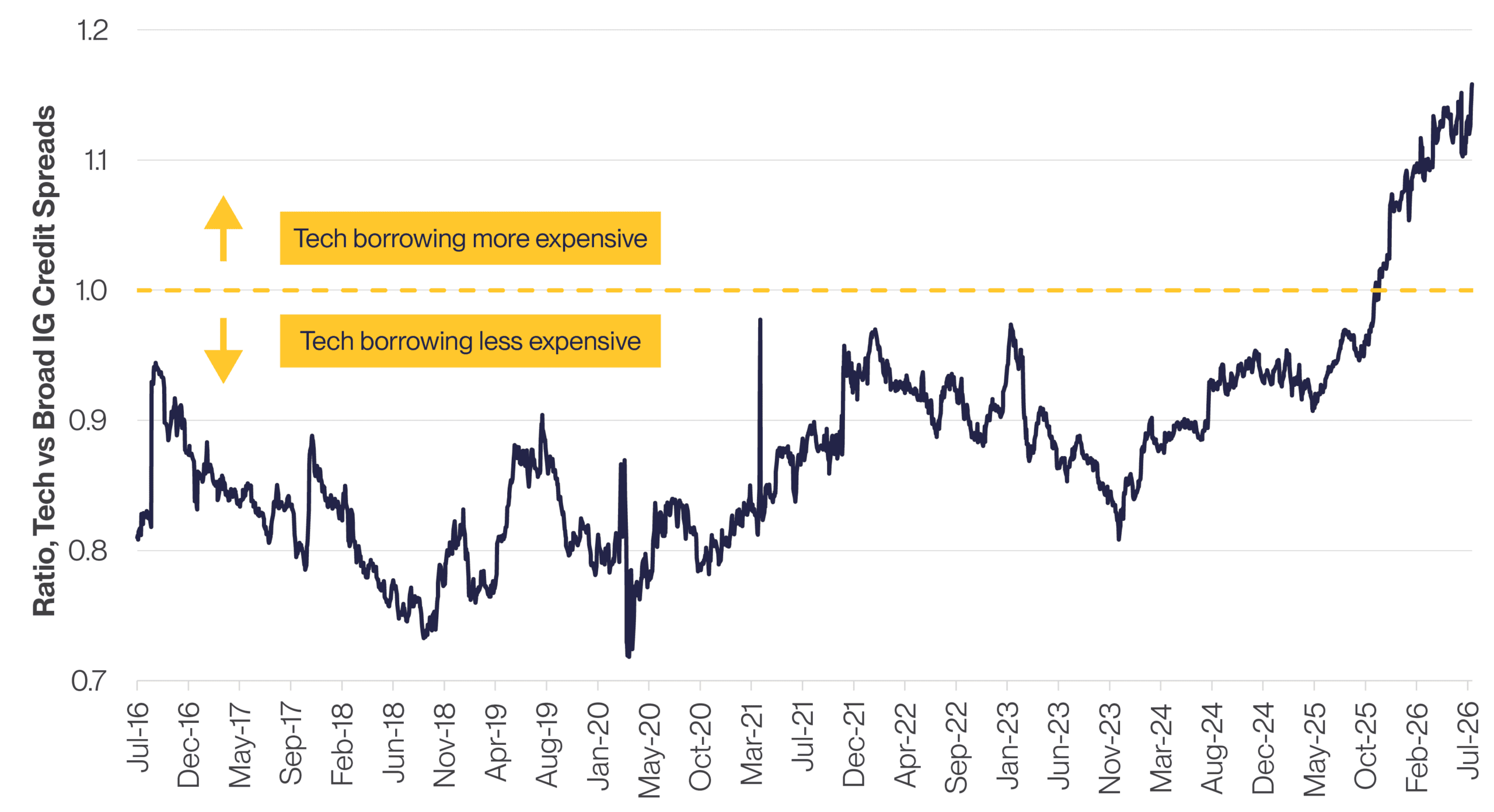
In the past, tech companies generally spent relatively little on physical assets such as factories, in sharp contrast to the “old economy” stocks that have been out of favor for much of the last decade. That helped keep tech firms’ borrowing costs low, with the credit spreads on their debt about 14% lower than those of the broader universe of similarly rated companies. What’s more, the firms often self-funded new spending initiatives using the ample free cash flow they generated.
That dynamic has been flipped upside down, with tech companies today largely focused on expensive physical assets that, in some ways, look decidedly old-economy. That’s forcing some hyperscalers and others to look beyond their own free cash flow to a mix of debt and equity financing from the financial markets in order to keep funding their big AI plans.
The result: Tech companies are finding it more expensive than ever to access the money they need. Tech now pays a 16% premium to issue debt relative to the broader market (see the chart).
Tech Borrowing Costs are Rising
Bloomberg, calculations by Horizon, data as of 07/24/2026
IG = Investment Grade
These fundamental shifts are prompting investors to rethink the risks among tech stocks. Last week, for example, shares of Google’s parent company Alphabet fell 7% after reporting that, for the first time since 2004, Google spent more cash during a quarter than it generated. Meanwhile, shares of SpaceX, which is building data centers, have fallen roughly 50% from their post-IPO high.
The upshot: It’s likely becoming more important to assess individual tech companies’ spending, debt levels and growth prospects rather than expect tech stocks as a group to rise and fall in lockstep. We see the ability to be highly selective about both equity and fixed income investment holdings as a significant advantage in today’s market.
This commentary is written by Horizon’s asset management team. Past performance is not indicative of future results. Nothing contained herein should be construed as an offer to sell or the solicitation of an offer to buy any security. This report does not attempt to examine all the facts and circumstances that may be relevant to any company, industry, or security mentioned herein. We are not soliciting any action based on this document. It is for the general information of clients of Horizon Investments, LLC (“Horizon”). This document does not constitute a personal recommendation or take into account the particular investment objectives, financial situations, or needs of individual clients. Before acting on any analysis, advice, or recommendation in this document, clients should consider whether the security in question is suitable for their particular circumstances and, if necessary, seek professional advice. Investors may realize losses on any investments. Asset allocation cannot eliminate the risk of fluctuating prices and uncertain returns. All investing involves the risk of loss.
References to indices, or other measures of relative market performance over a specified period of time are provided for informational purposes only. Reference to an index does not imply that any account will achieve returns, volatility or other results similar to that index. The composition of an index may not reflect the manner in which a portfolio is constructed in relation to expected or achieved returns, portfolio guidelines, restrictions, sectors, correlations, concentrations, volatility or tracking error targets, all of which are subject to change. It is not possible to invest directly in an index. Information obtained from third party sources is believed reliable but has not been vetted by the firm or its personnel.
The investments recommended by Horizon are not guaranteed. There can be economic times when all investments are unfavorable and depreciate in value. Clients may lose money. This commentary is based on public information that we consider reliable, but we do not represent that it is accurate or complete, and it should not be relied on as such. The opinions expressed herein are our opinions as of the date of this document. These opinions may not be reflected in all of our strategies. We do not intend to and will not endeavor to update the information discussed in this document. No part of this document may be (i) copied, photocopied, or duplicated in any form by any means or (ii) redistributed without Horizon’s prior written consent. Forward-looking statements cannot be guaranteed. Other disclosure information is available at www.horizoninvestments.com.
Horizon Investments is a registered trademark of Horizon Investments, LLC
©2026 Horizon Investments, LLC.