


Overview
The artificial intelligence (AI) initial public offering (IPO) wave is arriving, and the offerings coming to market are unlike any in recent memory. SpaceX has filed its prospectus and may begin trading as early as the second week of June. OpenAI is preparing to file confidentially ahead of a listing later this year. Anthropic has just closed a $65 billion Series H round at a $965 billion valuation and filed confidentially, targeting a late summer or fall debut. Combined, the three offerings could demand north of $200 billion from public markets. Comparatively, the entire U.S. IPO market raised just $45 billion in all of 2025.
These are some of the defining technology companies of the early AI era. They will likely generate more client questions and more pressure to act quickly than anything in recent memory. Understanding how to think about them starts with two foundational concepts.
First, an IPO is a financing event for the company going public, a mechanism for raising the capital needed to fund future growth. Second, it’s a liquidity event for early investors and company insiders, giving those who backed the company in its earliest stages an opportunity to convert their stakes into cash. Retail investors often get excited about new offerings because they misunderstand these two goals and who the process is designed to serve. That does not mean IPOs cannot be excellent investments for retail investors. Some of the greatest wealth-creation events in modern market history have come through public offerings. But the process, the valuations, and the historical record all suggest that enthusiasm is not a substitute for a clear framework. In this piece, we aim to provide that by examining:
- How the IPO process works and who is involved
- How investors may want to evaluate these specific offerings
- How today’s AI IPOs compare structurally to the 1990s tech wave
- What the long-run historical evidence on IPO performance tells us about the road ahead
The IPO Process
When a company decides to go public, it hires investment banks to underwrite the IPO. Those banks conduct a roadshow to create institutional demand and set an IPO price based on that demand. Institutional investors can access shares at the designated IPO price, while retail investors rarely have that same access. Retail investors typically buy after trading begins, often paying far more per share than insiders and institutions.
Two structural dynamics then influence price behavior in the months that follow.
The lock-up expiry: After an IPO, lock-up agreements typically prevent company insiders from selling their shares for 90 to 180 days. When that window opens, a significant amount of new supply can hit the market at once, driven less by the company’s business performance and more by liquidity demand. This can create meaningful downward price pressure regardless of how the underlying business is performing.
The index inclusion process: As newly listed companies join major indices like the S&P 500 and Russell 1000, passive funds must purchase shares regardless of price or valuation. The size of these IPOs will render this formerly obscure process a major focus for market participants in the months ahead.
Evaluating an IPO
When evaluating an IPO, we think it’s important to ask four questions to help separate signal from noise:
What is the motive? Why is this company deciding to go public now? We think a specific capital need, like accelerating a product or building infrastructure, is a more credible answer than “the market is hot.” In this case, the companies coming to market do have genuine and substantial capital requirements. The timing is not coincidental: demand for private tech shares has been voracious, and institutional and retail money alike have spent years accessing AI via proxy. They have been buying Nvidia for chip exposure, Microsoft for its OpenAI stake, and Alphabet for its DeepMind and Anthropic positions. The companies going public now (and their bankers) know that pent-up demand exists and are pricing accordingly.
Who is selling? A primary offering, in which the company sells new shares to raise capital for the business, is the more credible structure. It means founders and early investors are not exiting, and the proceeds are going back into the company. An offering with a heavy secondary component, where existing shareholders sell their stakes, signals that the people who know the business best are reducing their exposure. For example, SpaceX’s offering appears to be structured primarily as a capital raise, which is the right approach for a company with genuine capital needs.
Does the valuation make sense? IPOs are priced on demand, not intrinsic value. SpaceX is filing at $1.75-2.0 trillion against 2025 revenue of approximately $16 billion and a $4.9 billion net loss. OpenAI attracted an $852 billion valuation in its last private round against $20 billion in annualized revenue. Anthropic reported a $47 billion revenue run rate and expects its first operating profit this year. These are very different businesses with very different financial profiles at broadly similar, and high, valuations.
What does the prospectus say? The prospectus contains the definitive breakdown on all of the above: who is selling, how proceeds will be used, and the full financial picture.
Comparing Historical IPO Waves to the Present
To understand what is different about today’s wave, it helps to examine prior waves. In the 1990s, public markets were the primary source of growth capital. Amazon went public in 1997 at a valuation of $438 million, with less than $16 million in annual revenue, just three years after its founding. Netscape was barely a year old at its IPO, valued at around $2 billion on its first day of trading. Google went public at a $23 billion valuation in 2004. Facebook, then the largest tech IPO on record, debuted at $104 billion in 2012 when it was eight years old. In the 1990s, hundreds of companies entered the public markets each year, giving investors a broad set of opportunities. Today’s IPO wave revolves around a handful of companies that are going public later, larger, and at higher valuations than their 1990s counterparts.
Exhibit 1: Number of IPOs by Year (1990-2025)
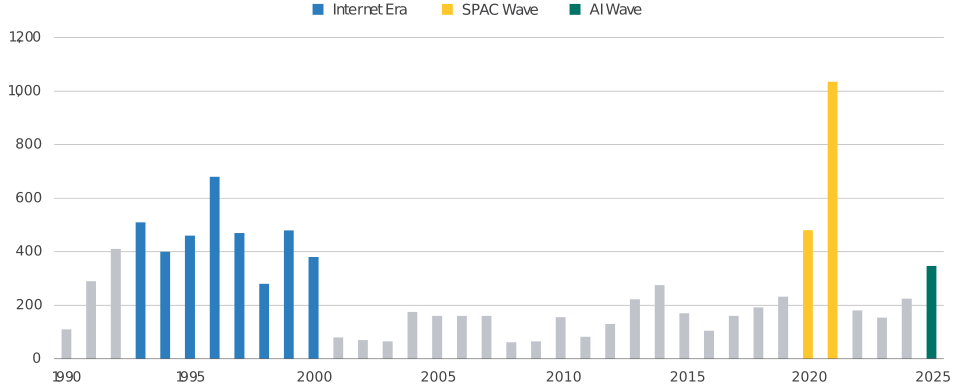
Jay Ritter, University of Florida, data as of 06/05/2026.
The difference isn’t that these are better businesses. Over the past two decades, private capital markets have expanded dramatically, providing growth funding that once came primarily from public investors. Venture capital, private equity, and sovereign wealth funds now deploy hundreds of billions of dollars, allowing companies to reach enormous scale before going public. By the time firms like SpaceX or OpenAI eventually list, much of their most explosive growth may already have accrued to private investors.
That is not necessarily a problem. Amazon, Google, and Facebook generated substantial gains both before and after their IPOs, creating enormous value for public shareholders. The key difference today is the starting point. Public investors are often entering later and at much higher valuations, making disciplined analysis more important than ever.
Exhibit 2 illustrates this well. Anthropic’s estimated price-to-sales multiple of around 21x is comparable to Facebook’s at its 2012 IPO and considerably more grounded than SpaceX’s 110x or OpenAI’s 43x. These are not the same investment proposition and should not be evaluated as such.
Exhibit 2: Then vs. Now – IPO Valuations at a Glance
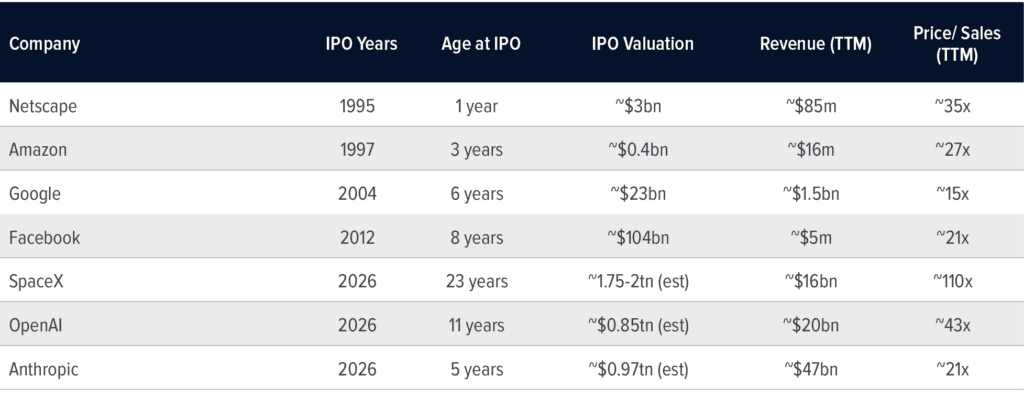
SEC EDGAR (historical prospectuses); SpaceX S-1 filing; press reports (OpenAI, Anthropic), 06/05/2026, TTM: Trailing Twelve Months
Historical IPO Performance and Volatility
The historical record on IPO performance reinforces the need for caution: the valuation at entry and timing can be as important as company quality. The average IPO underperforms the broader market over a three to five-year time horizon. According to research by Jay Ritter of the University of Florida, who has tracked IPO performance since 1991, the initial run-up accrues almost entirely to institutional holders. The 2020-2021 IPO cohort illustrates this clearly. Retail investors, flush with COVID-era stimulus, bid them up. After this initial demand, sustained underperformance followed as rates rose and growth multiples compressed. We are currently in a similarly hot macro environment, with risks of higher rates.
The biggest risk is not that these companies fail to create value over the long run. The journey to that value can be long, volatile, and unforgiving for investors who buy at the wrong price or sell at the wrong time. For example, investors who bought Amazon at its IPO in 1997 and held their shares through the dot-com collapse and the company’s eventual recovery earned significant rewards a decade later. However, the path was not linear, and timing mattered at every point along it. Investors who bought near the 1999 peak watched their gains evaporate, falling more than 90% from that high and facing years of losses before the stock recovered. Investors who bought at the IPO, rode the wave to the peak, and sold on the way down locked in losses on a company that went on to become one of the greatest wealth creators in market history. The experience of investors who bought at the wrong moment, or sold at the wrong moment, was a different story entirely.
The lesson is not to avoid these companies. It is to understand that volatility creates a specific and underappreciated risk: the combination of a strong initial run-up, the eventual evaporation of early gains, and the behavioral pressure to sell at precisely the wrong moment. Patience and entry point matter as much as conviction in the underlying business.
Exhibit 3: Amazon Stock Price, 1997-2007
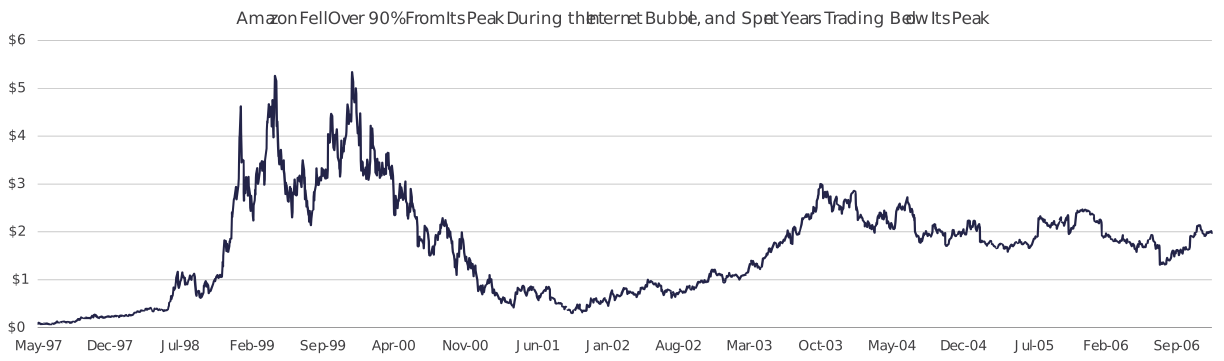
Bloomberg, Calculations by Horizon, 06/05/2026
Key Takeaways
We think the AI IPO wave of 2026 will test investors’ discipline in a nearly unprecedented way. We believe the investors most likely to generate strong risk-adjusted returns may not be those who buy on day one out of excitement, but those who do the research and critically evaluate the opportunity ahead:
The process favors institutions: The IPO is designed to serve the company and its early backers first. Retail investors almost always buy at higher prices than institutional allocators, and structural dynamics around lock-ups and index inclusion can create additional price volatility in the months that follow.
The primary/secondary split is a valuable signal: A company raising capital for its own use is more credible than one primarily serving insider liquidity. Read the prospectus.
Today’s wave is structurally different from prior ones: Public investors are entering at a later stage and at much higher starting valuations than prior technology waves. That does not foreclose the opportunity, but it changes the analysis required to appraise it correctly.
History rhymes but does not repeat: The 1990s tech IPOs created enormous long-term wealth, but investors who bought at peak valuations or bought and sold at the wrong time often waited a decade to recover. The companies were transformative. The entry point and valuations still mattered.
It’s too early to say with confidence which of the AI IPOs will reward public investors and which will test their patience. What we can say is that a framework for evaluating them is critical, and we remain committed to helping financial advisors and their clients navigate these decisions with discipline rather than enthusiasm.