




FOCUS Quarterly Report | Q4 2025

The Productivity Payoff: AI’s Real-World Impact


OVERVIEW

As 2026 begins, the U.S. appears to be entering a new phase of rising productivity—one that may have major implications for the economy, the labor market, interest rates, and equity market performance in the coming months and years.

These productivity gains are fueled in large part by the enormous buildout of artificial intelligence (AI) technology. Collectively, technology companies are spending hundreds of billions of dollars creating infrastructure to both generate and satisfy voracious demand for AI services and solutions.

This expansion of AI capabilities has been the big story in recent years. Going forward, however, investors’ attention will increasingly be focused on AI’s real-world impact. As AI spreads through the economy and adoption deepens, enterprises should begin to realize a tangible, measurable payoff from AI. We believe productivity gains will be a major component of that payoff.


THE AI/PRODUCTIVITY CONNECTION

Productivity is one of the most important factors in determining a nation’s standard of living over the long run. Measuring it involves assessing the economy’s output (gross domestic product, or GDP) relative to the number of hours workers put in to produce it. What’s left over is productivity.

When productivity rises, people can get what they want faster, get more of it with less effort, and do so at lower cost. Rising productivity can support faster economic growth, raise wages, and help keep inflation contained.

Previous productivity-enhancing technology (such as railroads, autos, and telecommunications) required large-scale initial investments, as seen in Exhibit 1, which also shows that today’s massive ongoing AI spending is echoing those previous periods. AI is the latest example of a transformative technology development, laying the groundwork for higher growth and productivity.

EXHIBIT 1: A HISTORY OF TECH-DRIVEN GROWTH
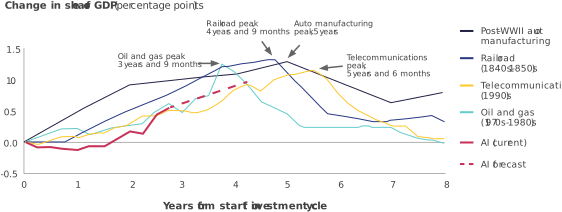
 
Note: This chart shows the change in the total size of different investment cycle as a share of real GDP. The period starting points are: Q1 1850 for railroad, Q1 1946 for post-WWII auto manufacturing, Q1 1980 for oil and gas, Q2 1995 for telecommunications, and Q3 2022 for AI (current). Gross domestic product (GDP) is the total monetary or market value of all the finished gooåds and services produced within a country’s borders in a specific time period.
Vanguard, 12/16/2025
Information obtained from third party sources is believed reliable but has not been vetted by the firm or its personnel. Past performance is not indicative of future results. Forward looking statements cannot be guaranteed.

Of course, there is a risk—albeit a low one, in our opinion—that AI-fueled productivity gains will not emerge or be as robust as expected. Monitoring AI adoption rates and bottom-line results across businesses will be essential for determining the pace and extent of productivity gains and other expected benefits of AI evolution.

That said, the AI buildout is already fueling productivity gains. Exhibit 2 shows that productivity in recent quarters has been rising significantly and is beginning to approach levels seen during past boom times, such as the 1990s (mass adoption of the internet) and the 1960s (broad-based, post-war standard of living improvements).

EXHIBIT 2: U.S. LABOR PRODUCTIVITY GROWTH (%)
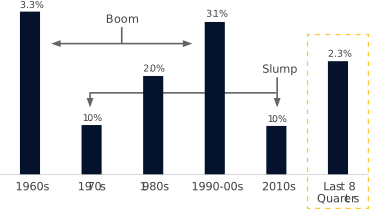
 
 
KKR, 09/302025 1960s refers to 1959-68; 1990s-00s refers to 1995-05; 1970s refers to 1973-79; 2010s refers to 2010-19; 1980s refers to 1980-88. Data as at June 30, 2025. Source: Bloomberg, Federal Reserve Bank of San Francisco.
Information obtained from third party sources is believed reliable but has not been vetted by the firm or its personnel.

Simply put, we believe we are in the early stages of what appears to be the next big wave of higher productivity and rising living standards.


PRODUCTIVITY’S IMPACT GOING FORWARD

Ongoing productivity improvements may reshape three core areas investors may want to consider when positioning their portfolios:

1. The economy and the labor markets

We think the big-picture economic case is clear. As AI technology grows and matures, becoming both cheaper and easier to implement, more companies will use it. That, in turn, will allow a higher percentage of workers to do their jobs more efficiently—thereby boosting output per worker and creating stronger, more sustainable economic growth.

AI’s impact on jobs will also be largely positive over time. Historically, for example, strong corporate investment in technology (the blue line in Exhibit 3) has been followed by sharply higher employment rates (the yellow line). In short, capital expenditures today likely mean jobs tomorrow.

EXHIBIT 3: TECH INVESTMENT AND JOB GROWTH
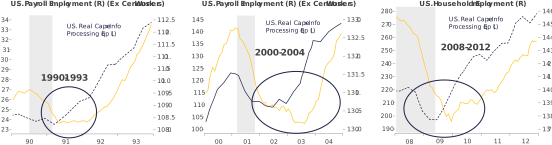
Capital Expenditures (Capex)
Piper Sandler, 11/02/2025
“Info processing eqp” (Information Processing Equipment) refers to tangible hardware like computers, peripherals, and communication gear, and intangible software, crucial for economic growth, involving the capture, storage, retrieval, and analysis of data, with key areas including computers, comms, and related items.
Past performance is not indicative of future results.
Information obtained from third party sources is believed reliable but has not been vetted by the firm or its personnel.

That said, the path may not be smooth for some workers. Disruptive technologies often initially create uncertainty and job displacement. What’s more, AI adoption will be inconsistent across industries, resulting in labor market conditions that vary by sector. But while some existing jobs will be lost, new ones will emerge as AI adoption redefines roles and how workers create and deliver value. That process, while likely to be messy and uneven, should ultimately lead to more opportunities.

2. Equity markets

The prospect of rising productivity is one of the strongest arguments for stocks’ ability to generate long-term wealth. Investors greatly value productivity gains, as theoretically the more robust economic growth those gains generate leads to higher corporate profits, which, of course, help support higher stock prices. As Exhibit 4 shows, stock prices generally align closely with corporate profits over time.

EXHIBIT 4: THE RELATIONSHIP BETWEEN CORPORATE PROFITS AND STOCK PRICES
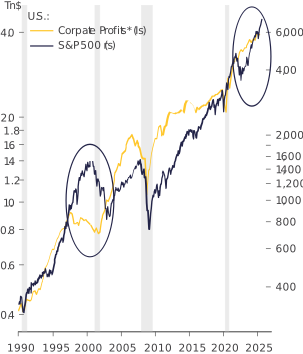
 
*National Income and Product Accounts before taxes
Note: Shading denotes U.S. recessions
The S&P 500 or Standard & Poor’s 500 Index is a market-capitalization-weighted index of the 500 largest U.S. publicly traded companies. It is not possible to invest directly in an index. Alpine Macro, 11/03/2025
Past performance is not indicative of future results. Information obtained from third party sources is believed reliable but has not been vetted by the firm or its personnel. 

The expected productivity gains should be increasingly broad and widespread, as AI evolves from being “tech cool” to a relatively small number of users to being “business cool” and is implemented by a growing number of small and large companies across a wide range of industries.

One key investment implication of that evolution: Diversification across market caps and sectors will remain a crucial component of investment portfolio construction. As more industries realize AI’s productivity-enhancing advantages on their bottom lines, stock market returns are likely to broaden out to include a more diverse group of strong performers than we’ve seen lately. Whereas the AI-buildout stage has primarily favored large tech companies, the impending AI-adoption stage may see attention shift to more non-tech businesses and smaller firms.

In fact, we are already seeing this rotation to some extent, as shown in Exhibit 5.

EXHIBIT 5: MARKET RETURNS BROADENING OUT FROM JUST THE “AI WINNERS”
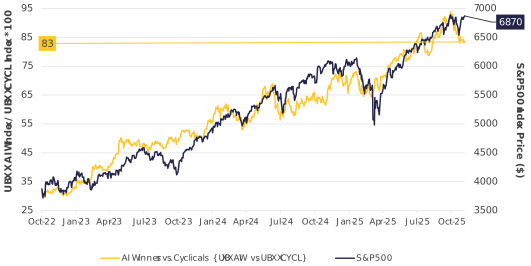
The S&P 500 or Standard & Poor’s 500 Index is a market-capitalization-weighted index of the 500 largest U.S. publicly traded companies. “AI Winners” are represented by the UBXXAIW index, a custom index that tracks the performance of 45 US-listed stocks identified by UBS research as being at the forefront of the generative artificial intelligence (AI) industry. Cyclical stocks are highly sensitive to economic fluctuations, outperforming the market when the economy is booming (e.g., low unemployment, high consumer confidence) and underperforming when it is contracting. Industries considered cyclical generally involve purchases that consumers and businesses can easily delay when money is tight. It is not possible to invest directly in an index UBS Macro Equity, 12/08/2025
Past performance is not indicative of future results. Information obtained from third party sources is believed reliable but has not been vetted by the firm or its personnel.

Ultimately, this productivity trend is expected to be a catalyst for positive overall equity market returns and a larger pool of winning stock market performers.

3. Interest rates and borrowing costs

Productivity’s potential impact on interest rates might surprise some investors. Consider an environment such as the one outlined above, in which rising productivity helps create stronger economic growth. In that scenario, interest rates can remain relatively high—certainly higher than during the low-growth pre-pandemic years—without causing broad economic harm.

We’ve seen this before, of course: When productivity was rising rapidly during the 1990s, the yield on the two-year Treasury averaged more than 2% higher than its current level. It’s worth noting that while short-term rates (which are highly influenced by Fed action) have fallen recently, rates on longer-term bonds (such as the 10-year Treasury) that reflect growth expectations have risen—driven in part by investors’ positive outlook for the economy.

However, this shift to a “higher normal” interest rate environment would require an adjustment period (and some discomfort in areas such as housing affordability) before becoming widely accepted in the market. Among Fed members today, for example, there’s a much wider range of estimates than is typical as to what a “normal” or neutral level of rates should look like (see Exhibit 6). Notably, Fed Chair Powell compared last year’s rate-cut decision to driving through fog. Persistent tariff-related confusion and delayed economic data from the lengthy government shutdown created significant uncertainty.

As productivity gains’ impact on the economy becomes more apparent, that fog and confusion should fade, replaced by greater clarity—ultimately allowing for smoother, more consistent economic conditions even if interest rates don’t fall significantly.

EXHIBIT 6: Number Of Different Estimates Of “Neutral Interest Rates” Among Federal Open Market Committee (FOMC) Members
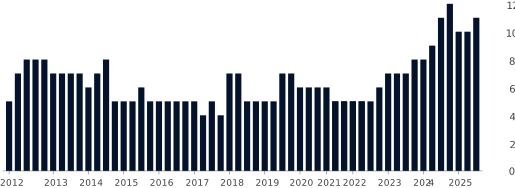
Bloomberg, 12/02/2025
Information obtained from third party sources is believed reliable but has not been vetted by the firm or its personnel.

KEY TAKEAWAYS

The tech-driven AI buildout is setting the stage for tangible productivity gains and other benefits for companies in virtually every sector of the economy. As AI’s real-world impact expands and becomes apparent, opportunities should emerge to drive stronger economic growth, greater efficiency, more robust corporate profits, and new approaches to value creation:

  • The AI opportunity is evolving from infrastructure buildout to real productivity gains across the economy.
  • Rising productivity can support stronger growth and higher wages, contain inflation, and allow for higher interest rates without derailing growth.
  • Productivity gains favor broader equity market leadership beyond large-cap tech stocks.

As we look towards 2026 and beyond, we think these opportunities can also fuel financial gains that can potentially enable goals-based investors to better pursue their most important objectives in the months and years to come.

Past performance is not indicative of future results. The commentary in this report is not a complete analysis of every material fact with respect to any company, industry, or security. The opinions expressed here are not investment recommendations but rather opinions that reflect the judgment of Horizon as of the date of the report and are subject to change without notice. Opinions referenced are as of the date of publication and may not necessarily come to pass. Forward-looking statements cannot be guaranteed.
The Nasdaq-100 is a stock market index made up of equity securities issued by 100 of the largest non-financial companies listed on the Nasdaq stock exchange. The S&P 500 or Standard & Poor’s 500 Index is a market-capitalization-weighted index of the 500 largest U.S. publicly traded companies. The MSCI ACWI ex-U.S. captures large and mid-cap representation across 22 Developed Markets and 24 Emerging Markets countries and excludes the U.S. The S&P SmallCap 600 Index (S&P 600) is a stock market index that tracks the small-cap segment of the US equity market. References to indices, or other measures of relative market performance over a specified period of time, are provided for informational purposes only. Reference to an index does not imply that any account will achieve returns, volatility or other results similar to that index. The composition of an index may not reflect the manner in which a portfolio is constructed in relation to expected or achieved returns, portfolio guidelines, restrictions, sectors, correlations, concentrations, volatility or tracking error targets, all of which are subject to change. Indices are unmanaged and do not have fees or expense charges, both of which would lower returns. Individuals cannot invest directly in any index.
We do not intend and will not endeavor to provide notice if and when our opinions or actions change. Horizon is not soliciting any action based on this document. This document does not constitute an offer to sell or a solicitation of an offer to buy any security or product and may not be relied upon in connection with the purchase or sale of any security or device. The investments recommended by Horizon are not guaranteed. There can be economic times when all investments are unfavorable and depreciate in value. Clients may lose money.
Information has been obtained from sources considered to be reliable, but accuracy and completeness cannot be guaranteed.
Horizon Investments is an investment advisor registered with the U.S. Securities and Exchange Commission. Registration does not imply a certain level of skill or training. More information about Horizon’s investment advisory services can be found in our Form ADV Part 2, which is available upon request.
NOT A DEPOSIT | NOT FDIC INSURED | MAY LOSE VALUE | NOT BANK GUARANTEED | NOT INSURED BY ANY FEDERAL GOVERNMENT AGENCY
Horizon Investments is a registered trademark of Horizon Investments, LLC.
© 2026 Horizon Investments, LLC.

Follow us on:

You are now leaving this website to go to HorizonMutualFunds.com