




FOCUS Quarterly Report | Q1 2026

Built to Last: The U.S. Economy’s Case for Resilience


OVERVIEW

The U.S. economy didn’t stumble into 2026 from a position of vulnerability. It arrived with genuine momentum. Consumers were spending from a place of strength, corporate earnings were running above trend, and the Federal Reserve’s 175 basis points of rate cuts over the prior 18 months had meaningfully eased financial conditions across the economy.

Beneath those headline strengths, a set of durable tailwinds was quietly compounding:

  • Real wage growth continued to steadily add to household balance sheets.
  • The productivity gains of an AI-powered technology boom (still in its early innings) were expanding profit margins across the economy.
  • Fiscal policy was pulling in the same direction, with lower corporate tax rates and individual tax refunds providing a public-side boost, while surging private capital expenditure on AI infrastructure added another cherry on top.

We believe these tailwinds serve as a formidable counterweight to the first quarter’s most significant headwinds (one of which generated considerably more noise than substance):

  • Oil prices driven higher by the war in Iran
  • A balanced but fragile labor market
  • Private credit concerns

We’ll explore the potential impact of these headwinds and make the case for why American resilience is likely to come out on top.


Middle East Conflict and Oil Prices: A Different World Than the 1970’s

In the wake of the U.S.-Israeli attacks on Iran and the resulting on-again/off-again shutdown of the Strait of Hormuz, oil prices soared from $57 per barrel at the start of the year to $110 by the end of March. These developments left some concerned about a 1970s-style gas crisis and runaway inflation.

This oil price and supply shock is in no way helpful to the prospects for economic growth, consumer confidence, or inflation. But the extent of the harm will greatly depend on what we’re calling time under conflict. The impact will likely range from minimal to moderate if the disruption is relatively brief, whereas a longer conflict will cause greater economic damage.

With that said, the energy landscape (particularly in the U.S.) has significantly changed over the past 50 years, and the economy and consumers are in a much stronger position to weather this storm:

  • The economy and labor market are much more insulated from energy and oil price shocks than they used to be: As seen in Exhibit 1, a 10% increase in oil prices has been far less harmful to the employment rate in recent decades than it was during the late twentieth century. One key reason is that the economy’s “energy intensity” is far lower than it’s ever been, meaning it takes much less energy to produce each unit of economic output.

Exhibit 1: Effect of 10% Increase in Oil Prices on U.S. Labor Market (1 Year After the Increase)
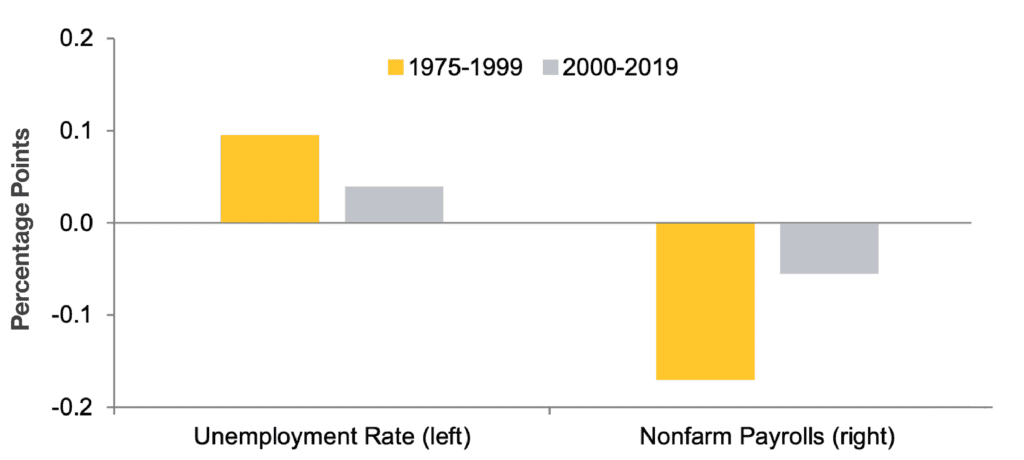
Exhibit 1

 
*Effects estimated with local projections using the exogenous oil price shocks in Känzig (2021). Goldman Sachs, 03/26/2026
  • Consumers spend less on energy: U.S. consumers spend far less on energy today as a percentage of their incomes than they did back in the 1970s and 1980s (see Exhibit 2).


Exhibit 2: U.S. Consumer Spending on Energy (As a Percentage of Income)Exhibit 2
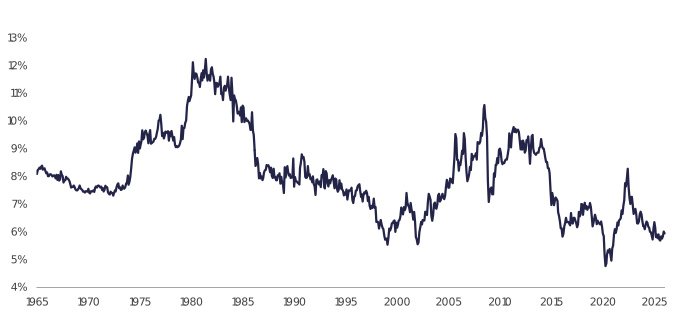
 
 
Bloomberg, calculations by Horizon, as of 01/31/2026.


In our view, the energy shocks of the 1970s played out under very different circumstances than today’s, leaving our current economy leaner, more resilient, and far better equipped to absorb oil price hikes.


The Labor Market: Stable But Fragile

Despite a turbulent geopolitical backdrop, U.S. equity markets opened 2026 on a solid footing, with the S&P 500 posting a 1.3% gain in January. That resilience was no coincidence, as the U.S. economy started the year from a position of notable strength, capping three consecutive years of exceptional equity market performance with a 17.9% return in 2025.

One key pillar of that resilience is the American consumer. Workers’ wages continue to grow faster than inflation, giving them more purchasing power and helping provide greater financial stability.

That said, even before the conflict in Iran began, there were signs of softening in the labor market. Of note, the average number of jobs created over the last six months is about 15,000, while at the end of 2024, that figure was 104,000. Despite the extreme volatility in month-over-month figures, the trend toward a cooling labor market is clear in the data.

The result is what’s described as a “low hire/low fire” environment, in which companies are reluctant to add workers yet equally hesitant to let existing ones go – leading to a decline in net job creation that has not been accompanied by a meaningful increase in the unemployment rate (see Exhibit 3).

Exhibit 3: Six-Month Moving Average for Nonfarm Payrolls
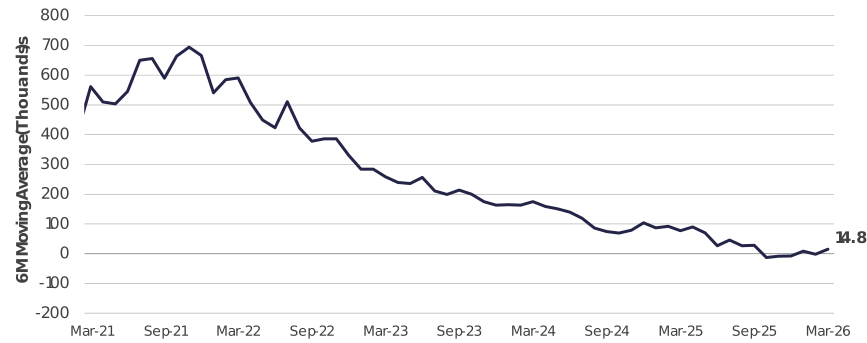
Exhibit 3

Bloomberg, calculations by Horizon, data as of 03/31/2026.

Much as we view the inflationary impacts of time under conflict, we believe consumers and businesses are well-positioned to weather this storm, provided the disruption remains relatively brief rather than protracted.


Private Credit: Problematic, But Not a Systemic Threat

Recent private credit headlines have been sensational enough to make en masse investor redemption requests seem rational. Terms like “catastrophe,” “crisis,” and “meltdown” are thrown around freely – pouring fuel on what is, in our view, a small fire.

Taking a step back (or several), private credit refers to business loans issued by institutions other than banks or publicly issued bonds. As banks retreated from high-risk lending after the 2008-2009 financial crisis, hedge funds, pension funds, and other large institutions moved in, helping the private credit market grow from $46 billion in 2000 to around an anticipated $2 trillion by 2026. More recently, cracks have appeared, particularly among software borrowers facing disruption from AI.

That pressure has rattled investors, with some rushing to redeem, only to run into the structural reality of private credit: limited liquidity. Cue 2008 echoes: illiquidity and opacity.

While losses are possible if defaults rise, we believe the current stress is unlikely to pose a systemic risk for two primary reasons:

  1. Size: Despite private credit’s rapid growth, it remains a relatively small component of the overall lending market. Private credit, as a percentage of households’ and businesses’ total loans and debt, remains a small share of private-sector debt, as shown in Exhibit 4 below.

Exhibit 4: Private Credit Remains a Small Percentage of all U.S. Private Sector DebtExhibit 4
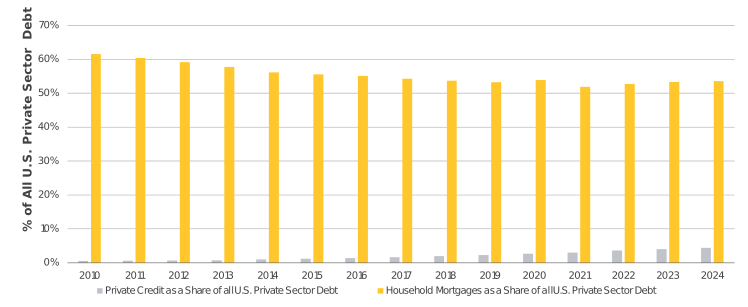
Federal Reserve of St. Louis & Bank for International Settlements, 03/31/2026
  1. Ownership: The largest holders of private credit are institutions with very long time horizons, as opposed to the banks reliant on short-term funding in the mid-2000s. With less leverage in the system, the big players in the private credit market are better positioned to weather any downturns in asset performance without panic selling.

Despite the noise, we do not believe this is the next 2008; rather, it’s a contained pocket of stress in an otherwise resilient system.


KEY TAKEAWAYS

The U.S. economy enters this period of turbulence not from a place of fragility, but from one of earned resilience, and we think the weight of evidence suggests that healthy growth will be sustained this year.

  • Energy shocks, reframed: Today’s economy is leaner and less energy-dependent than it was in the 1970s, meaning elevated oil prices, while unwelcome, are unlikely to deliver the body blow that prior generations experienced.
  • A labor market that bends without breaking: Hiring has cooled, but the low-hire/low-fire dynamic reflects caution, not collapse – and real wage growth continues to underpin consumer strength.
  • Private credit noise, not signal: The stress is real but contained, and the long-horizon institutional ownership of private credit is nothing like the leveraged, short-term-funded vulnerabilities that triggered 2008.

The headwinds of early 2026 are real, but they are neither novel nor insurmountable. For investors and consumers alike, the underlying architecture of this economy remains sound.

Past performance is not indicative of future results. The commentary in this report is not a complete analysis of every material fact with respect to any company, industry, or security. The opinions expressed here are not investment recommendations but rather opinions that reflect the judgment of Horizon as of the date of the report and are subject to change without notice. Opinions referenced are as of the date of publication and may not necessarily come to pass. Forward-looking statements cannot be guaranteed.
We do not intend and will not endeavor to provide notice if and when our opinions or actions change. Horizon is not soliciting any action based on this document. This document does not constitute an offer to sell or a solicitation of an offer to buy any security or product and may not be relied upon in connection with the purchase or sale of any security or device. The investments recommended by Horizon are not guaranteed. There can be economic times when all investments are unfavorable and depreciate in value. Clients may lose money.
Information has been obtained from sources considered to be reliable, but accuracy and completeness cannot be guaranteed.
Horizon is an investment advisor registered with the U.S. Securities and Exchange Commission. Registration does not imply a certain level of skill or training. More information about Horizon’s investment advisory services can be found in our Form ADV Part 2, which is available upon request.
Horizon Investments is a registered trademarks of Horizon Investments, LLC.
© 2026 Horizon Investments, LLC.
NOT A DEPOSIT | NOT FDIC INSURED | MAY LOSE VALUE | NOT BANK GUARANTEED | NOT INSURED BY ANY FEDERAL GOVERNMENT AGENCY

Follow us on:

You are now leaving this website to go to HorizonMutualFunds.com