



One of the top concerns we hear from advisors is the sustainability of U.S. government debt and how it could affect borrowing costs and markets. These aren’t ill-founded questions. Total government debt has passed $40 trillion, and the latest analysis from the Congressional Budget Office (CBO) projects that government debt held by the public will rise to 120% of GDP by 2036, meaningfully higher than the prior peak after World War II.
In our view, however, the short-term risks of a U.S. debt crisis are overblown. We believe the U.S. has unique advantages, and the current situation does not resemble a typical pattern of a debt crisis. Still, investors should not be complacent about potential long-term risks.
Key Points for Investors
- It’s not just the size of the debt that matters. We believe the relationship between the government’s borrowing cost and the economy’s growth rate is far more important than the headline level of debt.
- Credibility is critical. Debt becomes more dangerous when challenging fiscal dynamics are paired with a loss of confidence in the government’s willingness and ability to meet its obligations.
- The U.S. has important advantages. Its unique status in the global financial system provides meaningful flexibility, while stronger productivity growth could materially improve the long-term debt picture.
- Debt should inform portfolio decisions, not dictate them. Investors may want to look past near-term noise while preparing for structurally higher government debt, greater fixed income volatility, and tighter constraints on monetary and fiscal policy.
The Math Behind U.S. Debt
A brief detour into the dollars and cents of debt arithmetic. The U.S. government collects revenue through taxes and other sources and pays expenses, including interest on its debt, every year. Whatever remains at the end of the year is the budget balance. This amount is added to or subtracted from the existing debt load, and the process repeats.
The sustainability of this process depends on the relationship between the interest rate the government pays on its debt and the economy’s growth rate. When growth exceeds borrowing costs, and government revenue roughly matches its spending before interest payments, the debt-to-GDP ratio tends to stabilize or decline over time without requiring new policy action.
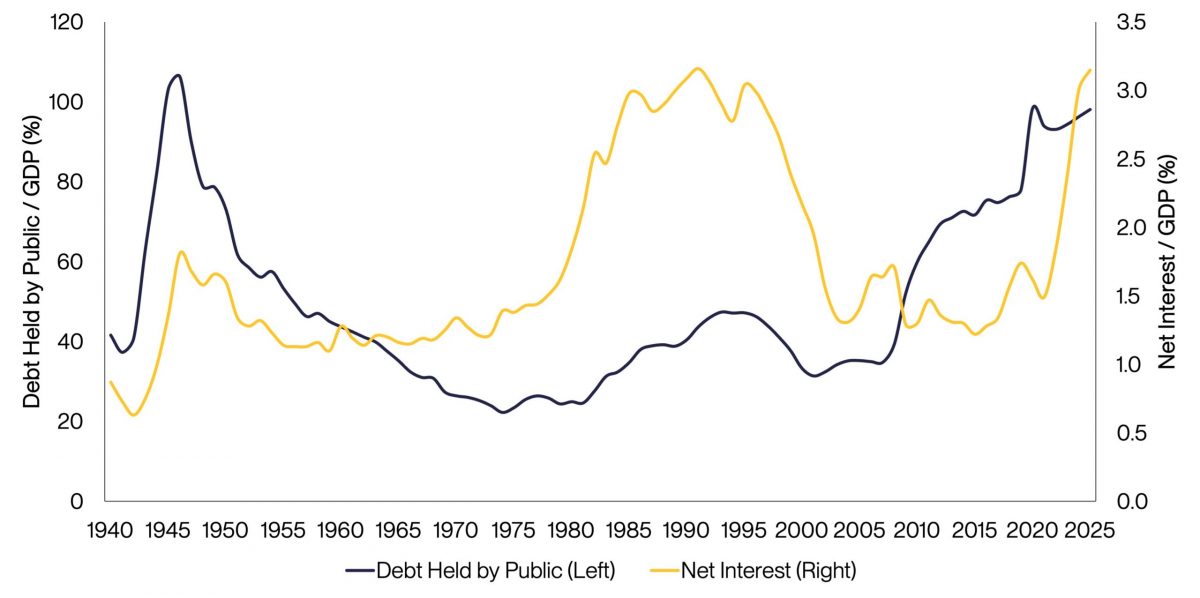
While much ink is spilled over the absolute size of U.S. debt, its percentage relative to GDP, and overall government spending, we think this reporting obscures the more important figure. We believe a better metric for evaluating the nation’s debt is net interest as a percentage of GDP. In other words, it may be a good idea to not focus on how much debt exists, but on how much it costs to service that debt, represented by the yellow line in chart 1.
Chart 1: U.S. Debt Size and Servicing Costs (1940 – 2025)
FRED, calculations by Horizon, data as of 12/31/2025
For much of the early post-World War II period and again during the extended low-rate era following the 2008 Global Financial Crisis (GFC), growth exceeded the interest rate on the debt. That dynamic helped contain debt growth despite persistent deficits. While debt service costs have risen rapidly over the past few years, we have been at these levels before. As Chart 1 shows, interest spending as a percentage of GDP (represented by the yellow line) stayed stable around current levels from the mid-1980s through the late 90s, a period of elevated economic growth and booming equity markets.
The Importance of Belief
A purely mechanical framing of debt dynamics ignores what we view as a critical piece of the equation: whether creditors believe the government will actually repay what it has borrowed. The word “credit” comes from the Latin for “to believe” or “to entrust”; credible and creed share the same root. What a government pays to borrow reflects, in part, the market’s confidence in its ability to meet its obligations. In our view, sovereign credibility rests on three pillars:
- Institutional Credibility: The rule of law, independent courts, the protection of private property rights, and a track record of honoring obligations. The U.S. has historically scored highly here, and we believe that will continue.
- Monetary Credibility: An independent central bank with the mandate and tools to preserve currency value and maintain a stable financial system. The U.S. record here has also been strong, as illustrated by the 2022-2023 interest-rate-tightening cycle and policy interventions during the GFC and the COVID-19 pandemic. Again, we see this continuing.
- Political Credibility: The capacity to make difficult fiscal choices when needed. The U.S. scores the lowest here. Recurring debt ceiling standoffs, chronic Congressional dysfunction, and an overreliance on executive orders suggest the political system could become a future vulnerability.
Investor perceptions of a country’s willingness to repay past debts vary widely. For example, Japan has maintained debt levels for decades that would likely be fatal for a less-trusted borrower, and yet it still pays some of the lowest interest rates in the world. Meanwhile, Argentina has defaulted on its sovereign debt nine times since it gained independence from Spain in 1816, and has rightly earned pariah status among global fixed income investors. Despite what the headlines may say, we believe the U.S.’s commitment to a rules-based order and faithful discharging of past debts is a deep and difficult-to-dislodge benefit to our nation and the world.
The Anatomy of a Debt Crisis
At Horizon, our investment team is focusing less on debt projections or political volatility in isolation and more on how they interact. History shows that a debt crisis typically requires both challenging debt dynamics and a broader loss of confidence.
Greece demonstrated this interaction in the early 2010s. The government borrowed in a currency it could not control (the Euro), and subsequent rising interest rates weakened its fiscal position. That further eroded creditor confidence, creating a self-reinforcing spiral that ended in debt restructuring and a nearly 30% economic contraction, comparable to what the U.S. experienced during the Great Depression.
Although sovereign debt crises are difficult to predict, one potential warning sign is a simultaneous decline in that country’s equities, bonds, and currency. This “triple sell-off” generally suggests investors may be losing confidence in the government itself rather than in any single asset class. The pattern appeared under U.K. Prime Minister Liz Truss in 2022 and briefly surfaced in U.S. assets following the spring 2025 tariff announcements.
A triple sell-off can be a warning but may not be itself a crisis. In both instances noted above, U.S. and U.K. policymakers responded by shifting toward what have historically been more “market-friendly” positions, helping restore confidence. Ultimately, we think the outcome depends on whether policymakers heed the market’s warning and adjust course or allow the loss of confidence to spiral.
How We Think About U.S. Debt Risk Today
In our view, the U.S. is not Greece or the U.K., and our willingness and ability to repay our debt are uniquely embedded in the global financial system. We also have the reserve-currency status on our side. Because the U.S. borrows in its own currency and supplies U.S. Treasuries as the world’s de facto “safe-haven” asset, it cannot be forced into default the way a country borrowing in a foreign currency can. This arrangement also lowers interest rates on our debt, a structural advantage so longstanding that the Finance Minister of France first complained of it in the 1960s. The U.S.’s “exorbitant privilege” is not something to squander or abuse, but in our view, it makes comparisons to Greece, Japan, or Argentina woefully incomplete.
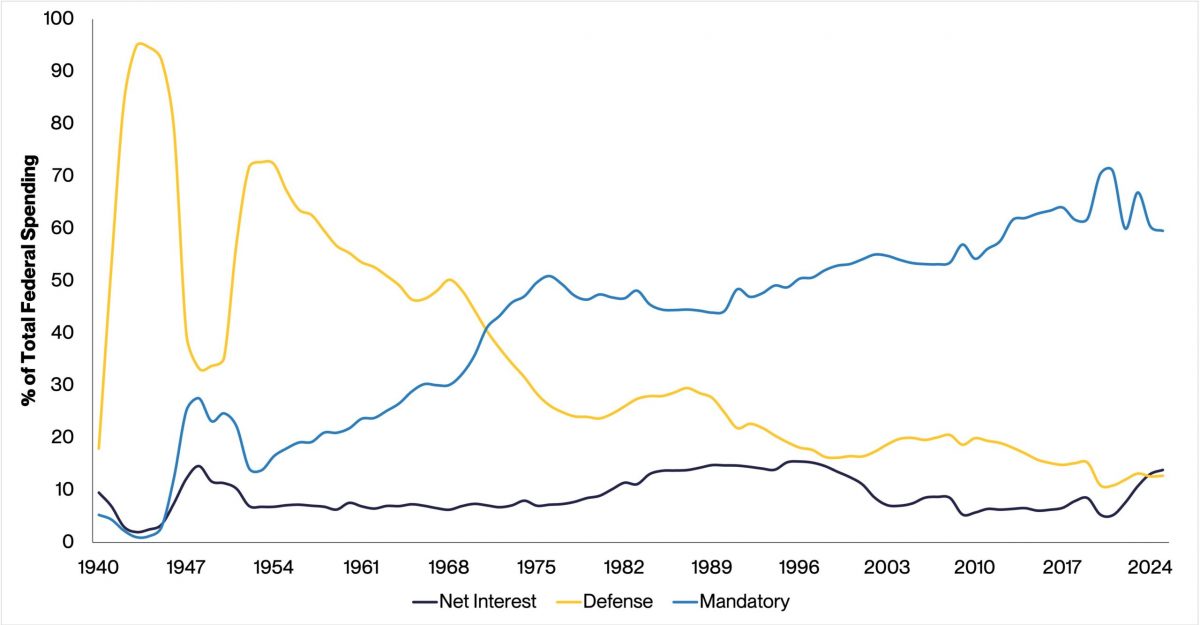
Regardless of our “special” status, the recent rise in interest rates has increased the risks to our long-term debt outlook. Additionally, U.S. budgetary dynamics appear to have taken a structural turn for the worse, despite the strength of the U.S. economic expansion in the post-COVID period. As Chart 2 shows, net interest payments have now surpassed defense spending as a share of GDP, and interest is the third-largest line item in the Federal Budget after Social Security and Medicare. Mandatory items increasingly dominate government spending, and every dollar going to debt service is one unavailable for the next emergency.
Chart 2: Where Government Spending Goes (1940-2025)
FRED, calculations by Horizon, data as of 12/31/2025
We think it is highly unlikely that the U.S. will default on its debt any time soon. We see the more pressing risk as losing the market’s belief in our credibility. Chronic legislative dysfunction that forecloses meaningful policy adjustment, actions that compromise central bank independence, and geopolitical turmoil are key vulnerabilities to U.S. credibility that we are monitoring. If market confidence in this credibility begins to falter, it could become self-fulfilling and make our government’s management of its obligations more difficult.
Can we grow our way out of this?
Time will tell. The last 100 years of economic history in the U.S. offer two examples of meaningful improvement in our debt profile. The U.S. exited World War II with net debt-to-GDP over 100%, higher than it is today. The country did not pay it down through painful austerity. Rather, it grew out of it, aided by deliberate action that suppressed borrowing costs during a decades-long post-war productivity boom. By the mid-1970s, the economy had grown by more than seven times while the debt had not even doubled, driving the debt-to-GDP ratio down to less than 30% from its 1945 peak, as shown in Chart 1 above.
The productivity boom brought on by the Internet Revolution offers a more recent example. After running persistent deficits during the 1980s and early 90s, the federal budget began to swing into surplus as productivity growth accelerated with, among other things, the diffusion of computers and networking infrastructure throughout the economy. As a result, the debt-to-GDP ratio fell by about 10 percentage points, its first meaningful decline in a generation. Projections around the turn of the new millennium called for falling debt for years to come, and fixed income traders pondered how they would deal with a dwindling supply of U.S. Treasuries.
We believe these two examples stand as underappreciated counterpoints to the budgetary doom and gloom so prevalent today. While many factors affected government finances and economic growth in these two analogs, one throughline is the power of productivity growth. That makes it important to monitor the developments in Artificial Intelligence (AI) and their impacts on productivity. It is hard to know how AI will reshape the economy in the years ahead; however, even one or two percentage points of additional annual economic growth could materially shift the math toward a more sustainable debt path.
Investing in a World of High Government Debt
We think the U.S. debt outlook is more nuanced than the headline numbers suggest. As we have stated, debt-service costs relative to economic growth and confidence in the U.S.’s commitment to meet its obligations matter more than debt size alone. That argues against letting debt headlines dictate major investing decisions. Episodic, policy-driven volatility could create entry points rather than exit signals.
The U.S. also retains important structural advantages, and stronger productivity growth could materially improve the long-term debt trajectory. We will continue to monitor market behavior for signs that investors are beginning to question U.S. credibility. But with the dollar elevated versus our trading partners’ currencies, healthy equity market valuations and earnings, and the 10-year Treasury yield near its 40-year average, we do not think today is that day.
Bigger picture, structurally higher government debt, elevated debt-service costs, and a more constrained policy environment point to greater fixed income volatility in the years ahead. How investors prepare will depend in part on whether inflation or weaker growth becomes the greater risk to the economy. We see two possible views:
- If inflationary concerns remain front and center, fixed income may not be as reliable a hedge against market turmoil as it was before 2020. Tactically risk-managed and option-hedged strategies, as well as other liquid alternatives, may play a more prominent role in managing volatility and drawdowns.
- If investors become more worried about the long-term growth outlook, high-quality fixed income, including long-duration government bonds, would likely continue to play an important role in portfolios.
Regardless of the path forward, we believe active fixed income solutions and more diversified equity strategies can help portfolios remain resilient and adaptable as the debt outlook evolves.