Inflation fears have dramatically shifted investor sentiment
After months of expecting the Federal Reserve Board to cut interest rates this year, investors have returned to a familiar refrain: “Higher for longer.”
The market today expects the federal funds rate—the Fed’s influential short-term interest rate—to finish 2026 at 3.73%, at the high end of its current target range of 3.50% to 3.75% (see the chart). That 3.73% represents a sharp jump of almost 70 basis points from just a month ago, when investors anticipated a series of three Fed rate cuts that would take the fed funds rate down to 3.05% by year-end.
The obvious culprit: Fears of rising and persistent inflation in the wake of the war with Iran, which has effectively cut off the roughly 20% of the world’s oil supply that comes from the Persian Gulf region, and which could prevent the Fed from cutting rates.
30-Day Federal Funds Rate
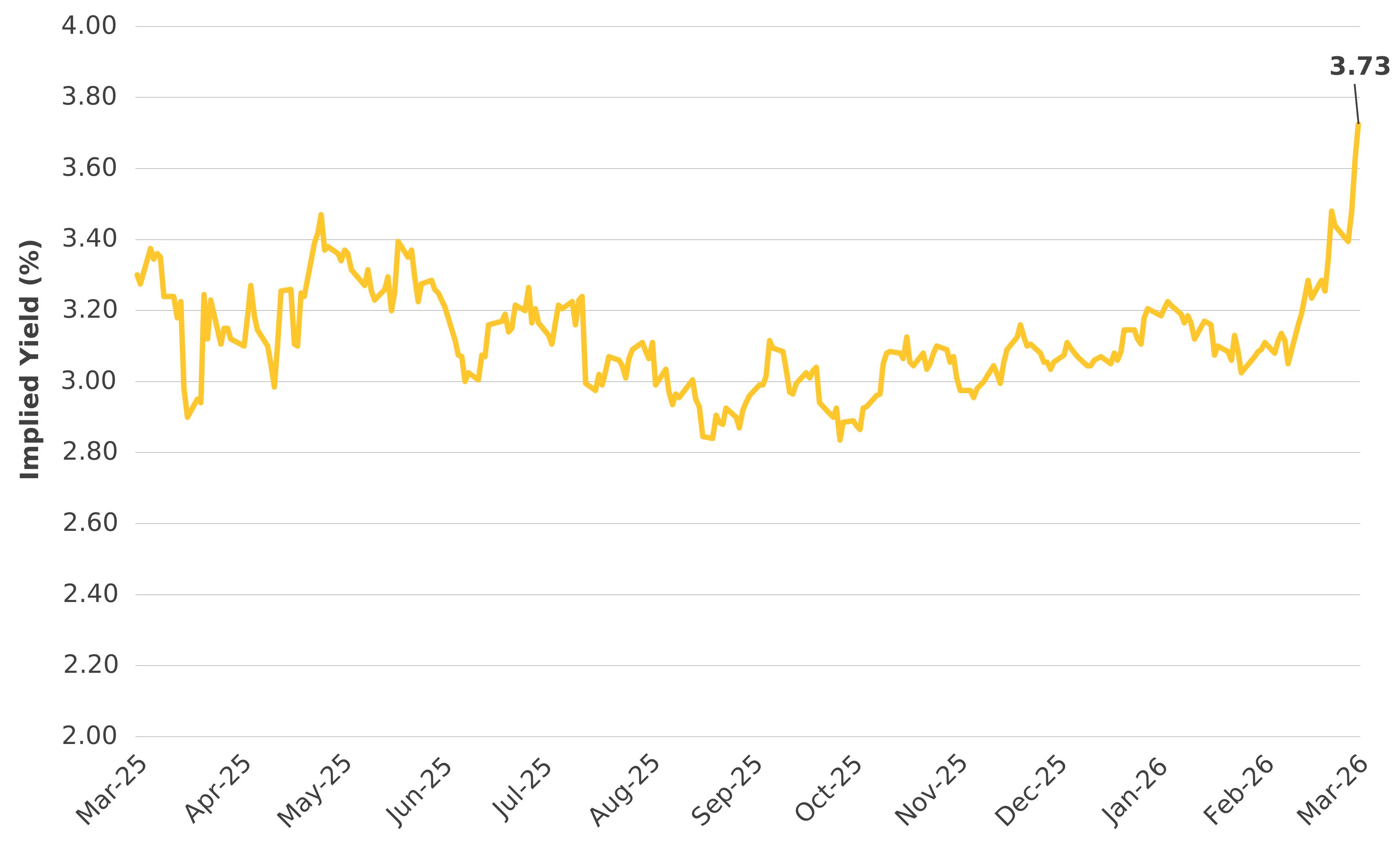
Bloomberg, calculation by Horizon, data as of 03/20/2026. Federal Funds rate estimated utilizing SOFR futures contracts. The Secured Overnight Financing Rate (SOFR) is a broad measure of the overnight cost of borrowing cash collateralized by Treasury securities. SOFR is one measurement that can be used to compute forward-looking term rates.
That war-fueled shift in investor sentiment has been the main force behind rising yields on both the 2-year Treasury note (up nearly 50 basis points since late February) and the 10-year Treasury note (up more than 40 basis points). Last week, commentary from other central banks in England, Europe, and Japan reflected this sentiment, putting upward pressure on global rates. Meanwhile, the Fed held its rate outlook steady in the dot plot and the Summary of Economic Projections (SEP), with a median December fed funds projection of 3.4%—implying just one cut in 2026. The market, though, wasn’t buying it.
The good news: While investors are pricing in extreme uncertainty about the future prospects for inflation, they appear to be far less concerned about economic growth at this point, as evidenced by the fact that longer-term bond yields haven’t fallen significantly. This would be expected with a slow-growth outlook. The Fed, too, increased its growth expectations, citing higher AI-driven productivity and a strong consumer.
Ultimately, the Fed finds itself in a tough place, given that inflation had not yet reached the Fed’s desired 2% target before the current oil price shock. Add labor market uncertainty to the mix, and the likely result is that Fed policy will be even more dependent than usual on each new data point that gets released. That may mean greater interest rate volatility for the time being, which in turn may hurt various market segments (mortgage rates and housing, for example) and overall investor sentiment.
References to indices, or other measures of relative market performance over a specified period of time are provided for informational purposes only. Reference to an index does not imply that any account will achieve returns, volatility or other results similar to that index. The composition of an index may not reflect the manner in which a portfolio is constructed in relation to expected or achieved returns, portfolio guidelines, restrictions, sectors, correlations, concentrations, volatility or tracking error targets, all of which are subject to change. It is not possible to invest directly in an index. Information obtained from third party sources is believed reliable but has not been vetted by the firm or its personnel.
This commentary is written by Horizon’s asset management team. Past performance is not indicative of future results. Nothing contained herein should be construed as an offer to sell or the solicitation of an offer to buy any security. This report does not attempt to examine all the facts and circumstances that may be relevant to any company, industry, or security mentioned herein. We are not soliciting any action based on this document. It is for the general information of clients of Horizon Investments, LLC (“Horizon”). This document does not constitute a personal recommendation or take into account the particular investment objectives, financial situations, or needs of individual clients. Before acting on any analysis, advice, or recommendation in this document, clients should consider whether the security in question is suitable for their particular circumstances and, if necessary, seek professional advice. Investors may realize losses on any investments. Asset allocation cannot eliminate the risk of fluctuating prices and uncertain returns. All investing involves the risk of loss.
The investments recommended by Horizon are not guaranteed. There can be economic times when all investments are unfavorable and depreciate in value. Clients may lose money. This commentary is based on public information that we consider reliable, but we do not represent that it is accurate or complete, and it should not be relied on as such. The opinions expressed herein are our opinions as of the date of this document. These opinions may not be reflected in all of our strategies. We do not intend to and will not endeavor to update the information discussed in this document. No part of this document may be (i) copied, photocopied, or duplicated in any form by any means or (ii) redistributed without Horizon’s prior written consent. Forward-looking statements cannot be guaranteed. Other disclosure information is available at www.horizoninvestments.com.
Horizon Investments is a registered trademark of Horizon Investments, LLC
©2026 Horizon Investments, LLC.