Context matters when rates are rising
Bond yields are the hot topic of the week due to two events:
- The Fed meeting to determine whether to raise a key short-term interest rate in an effort to reduce inflation.
- The yield on the 10-year Treasury note—which influences borrowing costs across the economy—exceeding 5% for only the second time since 2007.
Investors worry that rising bond yields will hinder the economic and corporate profit growth that helps fuel stock market gains. But in today’s environment, we believe that higher rates don’t necessarily mean restrictive rates, nor do they necessarily signal market stress.
Consider the 10-year Treasury’s real yield—the return above the market’s expected rate of inflation. That real yield is rising, currently at 2.59% (see the chart). Despite rising oil prices and concerns about fiscal deficits, much of the recent increase in Treasury yields has come from higher real yields as the economy remains resilient, rather than from higher inflation expectations.
What’s more, the increase in real yields has been largely concentrated in shorter-maturity bonds, whose yields are influenced mainly by expectations for Federal Reserve policy. Much of the recent rise in yields likely reflects investors repricing interest rates to higher, more typical levels after many years of historically abnormally low yields. The 10-year real yield shown in the chart reflects the market’s expected path for real short-term interest rates, plus compensation for holding longer-duration bonds. Both have been suppressed for many years and are now looking to be trending along a more traditional trajectory.
U.S. Treasury 10-Year Real Yield
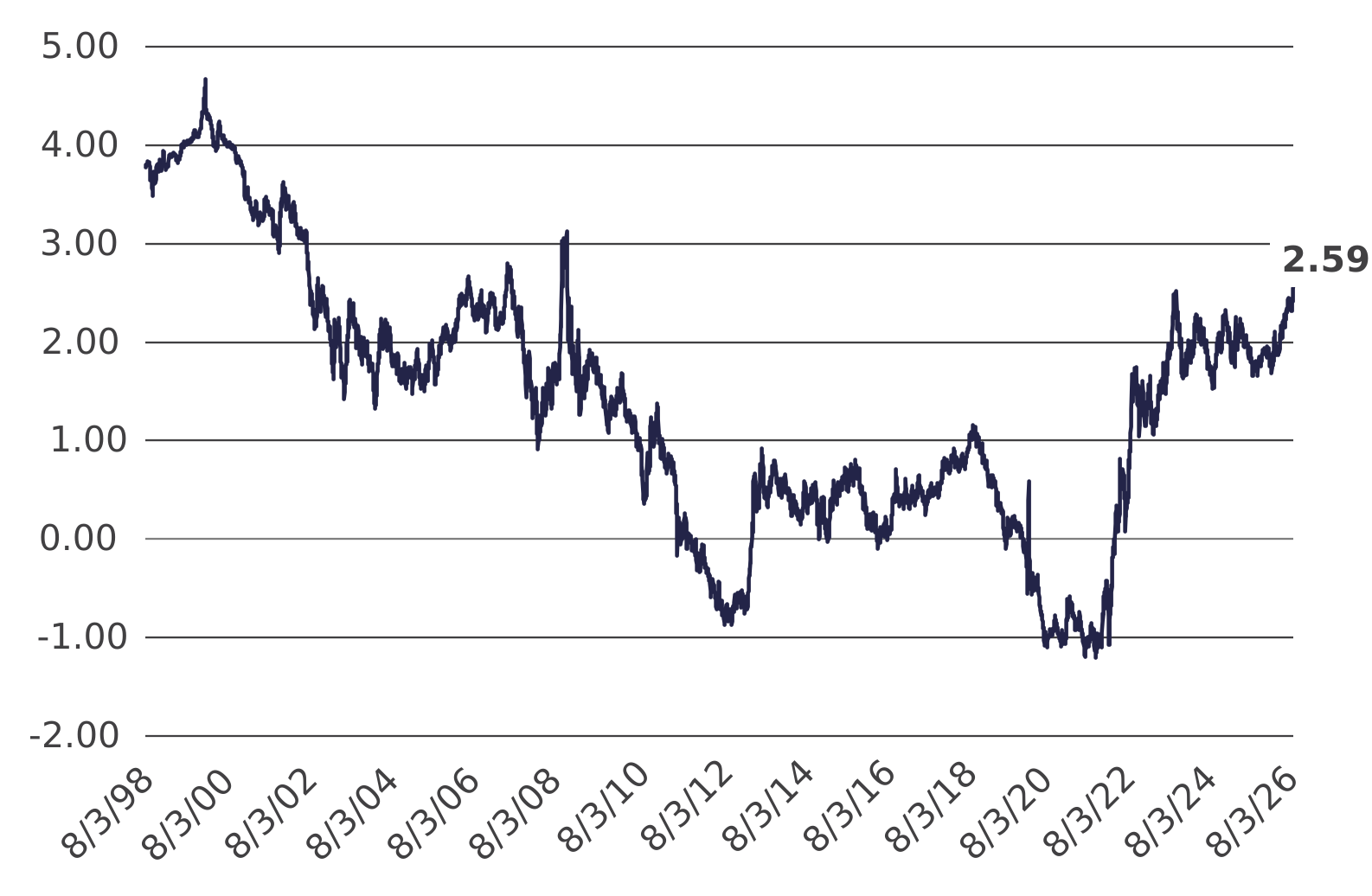
Bloomberg, calculations by Horizon, data as of 09/14/2026
Ultimately, today’s real yields on government bonds may indicate that the economy can continue to thrive—and that businesses and investors can continue to spend, invest, and take risks—despite higher yields. Indeed, Fed Chair Kevin Warsh noted just a few weeks ago that “real consumer spending has been healthy” and that he “would be hard pressed to describe broad financial conditions as restrictive.”
Yes, higher rates can put downward pressure on stock valuations. But context matters, and rising rates alongside the healthy growth we’re seeing today are very different from rising rates in a weakening economy.
The upshot: Instead of being a problem, we believe that today’s higher real yields are actually a result of economic strength—and a reflection of expectations for stronger future economic growth, a higher neutral policy rate, and more productive investment opportunities going forward.
This commentary is written by Horizon’s asset management team. Past performance is not indicative of future results. Nothing contained herein should be construed as an offer to sell or the solicitation of an offer to buy any security. This report does not attempt to examine all the facts and circumstances that may be relevant to any company, industry, or security mentioned herein. We are not soliciting any action based on this document. It is for the general information of clients of Horizon Investments, LLC (“Horizon”). This document does not constitute a personal recommendation or take into account the particular investment objectives, financial situations, or needs of individual clients. Before acting on any analysis, advice, or recommendation in this document, clients should consider whether the security in question is suitable for their particular circumstances and, if necessary, seek professional advice. Investors may realize losses on any investments. Asset allocation cannot eliminate the risk of fluctuating prices and uncertain returns. All investing involves the risk of loss.
The S&P 500 Index tracks the performance of 500 leading U.S. companies and is weighted by market capitalization. The S&P 500 Equal Weight Index includes the same companies as the S&P 500 but assigns each company an equal weight. References to indices, or other measures of relative market performance over a specified period of time are provided for informational purposes only. Reference to an index does not imply that any account will achieve returns, volatility or other results similar to that index. The composition of an index may not reflect the manner in which a portfolio is constructed in relation to expected or achieved returns, portfolio guidelines, restrictions, sectors, correlations, concentrations, volatility or tracking error targets, all of which are subject to change. It is not possible to invest directly in an index. Information obtained from third party sources is believed reliable but has not been vetted by the firm or its personnel.
The investments recommended by Horizon are not guaranteed. There can be economic times when all investments are unfavorable and depreciate in value. Clients may lose money. This commentary is based on public information that we consider reliable, but we do not represent that it is accurate or complete, and it should not be relied on as such. The opinions expressed herein are our opinions as of the date of this document. These opinions may not be reflected in all of our strategies. We do not intend to and will not endeavor to update the information discussed in this document. No part of this document may be (i) copied, photocopied, or duplicated in any form by any means or (ii) redistributed without Horizon’s prior written consent. Forward-looking statements cannot be guaranteed. Other disclosure information is available at www.horizoninvestments.com.
Horizon Investments is a registered trademark of Horizon Investments, LLC
©2026 Horizon Investments, LLC.