

Double-Check Your Diversification

A historic moment for the S&P 500 calls for investors’ attention

Diversification is a core tenet of prudent investing. But thanks to a historic market development, some investors who think they’re well-diversified may want to give their portfolio a closer look.

The reason: For the first time ever, the S&P 500—the well-known index of 500 large-cap stocks from 11 sectors that many investors use as a gauge for the broad stock market’s health—is no longer legally considered to be diversified according to rules established in the Investment Company Act of 1940, which regulates registered investment companies such as mutual funds and ETFs.

Here’s the test: Look at all of the stocks in any particular mutual fund or ETF. Find all those that have a weight of 5% or above and sum them up. If that total is above 25%, the investment can no longer be called “diversified.

As of last week, the value (or market cap) of each of the S&P 500’s top-four stocks (Nvidia, Apple, Microsoft, and Alphabet) now exceeds 5% of the index’s total market cap. The sum of those four names is about 27% (see chart), leading to a failure of the diversification classification.


The S&P 500 Is Now Undiversified
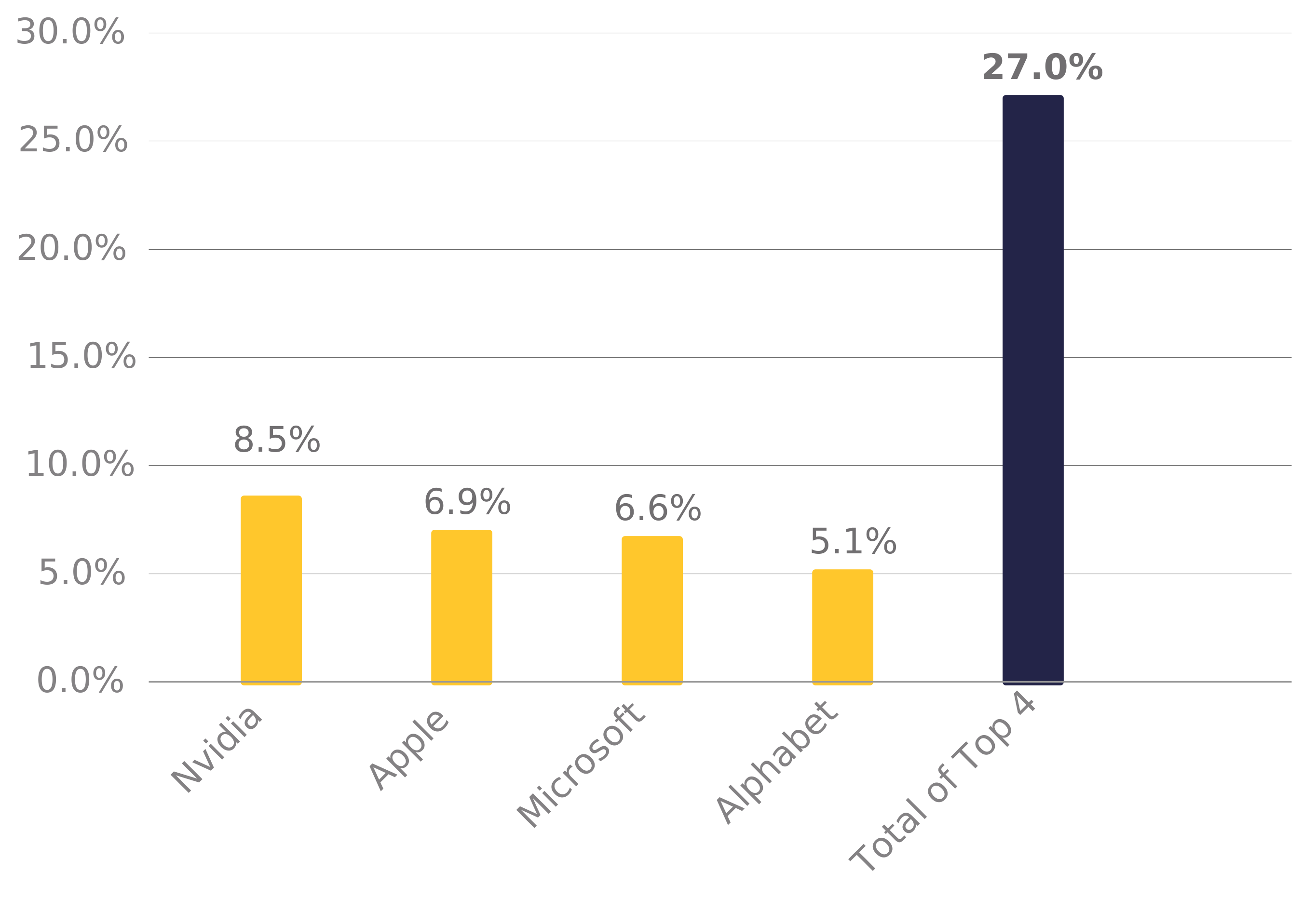
Bloomberg, calculations by Horizon, data as of 10/31/2025. This is not a recommendation to buy or sell any security. It is not possible to invest directly in an index.

Generally, insufficient diversification poses significant risks for investors. For example, returns can be disproportionately hurt by the poor performance of the biggest stocks in a portfolio with little to no diversification. In this case, a big, sudden decline in any one of these four tech stocks (or other Mag 7 stocks) could cause the entire S&P 500 index to drop sharply. That’s been true for a while now, but the risk has now risen to a new level.

Does all this mean investors should avoid the S&P 500? Of course not. The companies in that index include some of the most successful businesses in the world. Instead, keep these two key points in mind:

  • When market performance is driven by a small handful of stocks, many diversified strategies that hold a broad array of stocks simply cannot keep up, nor are they designed to.
  • Understand what you actually own when you invest in a fund. Then consider allocating other assets to strategies that aren’t as heavily concentrated—thereby ensuring greater diversification and helping you create a robust portfolio with a good balance of risk and return for your goals-based financial plan.
The Standard and Poor’s 500, or simply the S&P 500, is a stock market index tracking the stock performance of 500 leading companies listed on stock exchanges in the United States. References to indices, or other measures of relative market performance over a specified period of time are provided for informational purposes only. Reference to an index does not imply that any account will achieve returns, volatility or other results similar to that index. The composition of an index may not reflect the manner in which a portfolio is constructed in relation to expected or achieved returns, portfolio guidelines, restrictions, sectors, correlations, concentrations, volatility or tracking error targets, all of which are subject to change. It is not possible to invest directly in an index. Information obtained from third party sources is believed reliable but has not been vetted by the firm or its personnel
This commentary is written by Horizon’s asset management team. Past performance is not indicative of future results. Nothing contained herein should be construed as an offer to sell or the solicitation of an offer to buy any security. This report does not attempt to examine all the facts and circumstances that may be relevant to any company, industry, or security mentioned herein. We are not soliciting any action based on this document. It is for the general information of clients of Horizon Investments, LLC (“Horizon”). This document does not constitute a personal recommendation or take into account the particular investment objectives, financial situations, or needs of individual clients. Before acting on any analysis, advice, or recommendation in this document, clients should consider whether the security in question is suitable for their particular circumstances and, if necessary, seek professional advice. Investors may realize losses on any investments. Asset allocation cannot eliminate the risk of fluctuating prices and uncertain returns. All investing involves the risk of loss.
The investments recommended by Horizon are not guaranteed. There can be economic times when all investments are unfavorable and depreciate in value. Clients may lose money. This commentary is based on public information that we consider reliable, but we do not represent that it is accurate or complete, and it should not be relied on as such. The opinions expressed herein are our opinions as of the date of this document. These opinions may not be reflected in all of our strategies. We do not intend to and will not endeavor to update the information discussed in this document. No part of this document may be (i) copied, photocopied, or duplicated in any form by any means or (ii) redistributed without Horizon’s prior written consent. Forward-looking statements cannot be guaranteed. Other disclosure information is available at www.horizoninvestments.com.
Horizon Investments is a registered trademark of Horizon Investments, LLC
©2025 Horizon Investments, LLC.

Follow us on:

You are now leaving this website to go to HorizonMutualFunds.com