

Diversification in a New Bond Era

Investors typically regard bonds as a safe haven because of their reputation for having lower risk and lower return profile. For investors preparing for retirement, or those already in retirement, a common rule of thumb has been to shift away from equities into bonds. The phrase “own your age in bonds”, however, may need to be reconsidered in today’s market environment.

Sharply rising inflation in 2022 reminded investors that bonds are not always low-risk, as fixed income suffered steep losses. In the short term, they can sometimes lose a significant amount of money. The question now is what today’s data tells us about bonds’ role going forward. By examining yields, diversification benefits, and income potential, we can better understand how to position bonds and related strategies in today’s bond market. Chart 1 below illustrates that today’s yields can be an excellent predictor of future returns.

CHART 1: CURRENT YIELD VS. FORWARD 10-YEAR RETURNS FOR INVESTMENT GRADE BONDS

Bloomberg Aggregate Bond Index
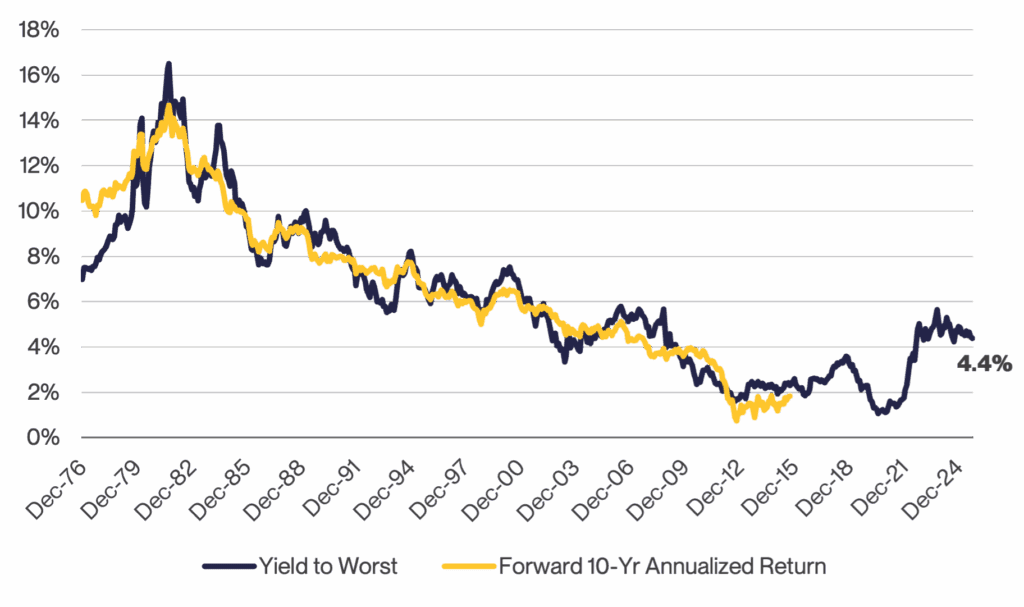
Bloomberg U.S. Agg Total Return Value Unhedged USD Index (LBUSTRUU) (bonds) from Bloomberg, December 1976 through September 2025, calculations by Horizon. Past performance is not indicative of future results. It is not possible to invest directly in an index. Please see attached disclosures.

Turning to diversification benefits, Chart 2 shows the rolling five-year stock and bond correlation at 0.6, the highest level on record over this period, as of September 2025. The prevailing level of inflation is a key factor driving correlations between stocks and bonds. These asset classes tend to exhibit negative correlations when inflation is roughly below 3%, such as during the years 2000 to 2021. Since the mid-1970s (except for the early 2000s), bonds have generally moved in step with stocks, especially during periods of elevated inflation.

CHART 2: ROLLING 5-YEAR STOCK AND BOND CORRELATIONS

Bloomberg U.S. Agg Total Return Value Unhedged USD (bonds) index and S&P 500 index (stocks) from Bloomberg, December 1976 through September 2025, calculations by Horizon. It is not possible to invest directly in an index. Please see the attached disclosures.

According to the New York Fed’s survey of consumer expectations, the median 1-year inflation outlook currently sits at 3.4%, while the University of Michigan’s 5-10 year longer-term survey has expectations at 3.7%. Persistently high inflation is arguably likely to remain, which could limit the ability of bonds to provide diversification.

Finally, turning to income potential, Table 1 compares yields across bonds, U.S. Treasury bills, and dividend stocks. A flat yield curve has left short-term Treasury bills offering income comparable to many bonds, while dividend-oriented equities, having largely missed the Artificial Intelligence-driven market rally, continue to provide relatively attractive yields. Taken together, both cash and dividend stocks deliver similar income potential to bonds, but without the same interest rate risk. 

TABLE 1: ESTIMATED INDEX YIELD OF BONDS, CASH, AND DIVIDEND STOCKS

U.S. Investment Grade Bond U.S. Treasury Bills U.S. Dividend Stocks

4.4%

4.0%

4.1%

Investment grade bonds are measured by the Bloomberg US Agg Total Return Value Unhedged USD Index, Treasury bills are measured by the Bloomberg US Short Treasury Index, and Dividend Stocks are measured by the Dow Jones U.S. Select Dividend Total Return Index  from Bloomberg as of 09/30/2025.

Summarizing these key points highlights why the traditional use cases of bonds may be more challenged than they once were:

  • Low real expected return: With a current yield of 4.4% and expected inflation as high as 3.7%, the ten-year forward real return (Chart 1) for investment-grade bonds may be less than 1%.
  • A lack of diversification from stocks: If inflation remains elevated, bonds may not hedge stocks as effectively as they used to (Chart 2).
  • Non-competitive income: U.S. Investment Grade Bonds currently yield 4.4%, only a small premium above cash and U.S. dividend stocks (Table 1).

While bonds have long served as a cornerstone for investors seeking to manage risk and reduce portfolio volatility, today’s macro environment challenges many of those traditional benefits. In this setting, other approaches such as tactical strategies, defensive equity, and the selective use of derivatives may help investors achieve similar objectives. These strategies could help manage downside risk, improve portfolio stability, and provide income. Ultimately, diversification across investment styles can be important for investors who are pursuing the outcomes they have historically relied on bonds to deliver and for supporting a goals-based investment plan built for today’s market realities.

Nothing contained herein should be construed investment advice or a recommendation to buy or sell any security or to adopt a particular investment strategy. This document does not take into account the particular investment objectives, financial situations, or needs of individual clients. Before acting on any analysis, advice or recommendation in this document, clients should consider whether the security in question is suitable for their particular circumstances and, if necessary, seek professional advice. Investors may realize losses on any investments.
Past performance is not a guide to future performance. This commentary is based on public information that we consider reliable, but we do not represent that it is accurate or complete, and it should not be relied on as such. Opinions expressed herein are our opinions as of the date of this document. We do not intend to and will not endeavor to update the information discussed in this document. Forward looking statements cannot be guaranteed. It should be noted that investment involves risks, the value of investments and the income from them may fluctuate in accordance with market conditions and taxation agreements. Neither past performance nor yield is a reliable guide to future performance.
The Bloomberg US Agg Index is a broad-based flagship benchmark that measures the investment grade, US dollar-denominated, fixed-rate taxable bond market. The Bloomberg US Short Treasury Index measures the performance of the US Treasury bills, notes, and bonds under 1 year to maturity. The Dow Jones U.S. Select Dividend Index aims to represent the U.S.’s leading stocks by dividend yield. References to indices, or other measures of relative market performance over a specified period of time are provided for informational purposes only. Reference to an index does not imply that any account will achieve returns, volatility or other results similar to that index. The composition of an index may not reflect the manner in which a portfolio is constructed in relation to expected or achieved returns, portfolio guidelines, restrictions, sectors, correlations, concentrations, volatility or tracking error targets, all of which are subject to change. It is not possible to invest directly in an index.

Follow us on:

You are now leaving this website to go to HorizonMutualFunds.com