

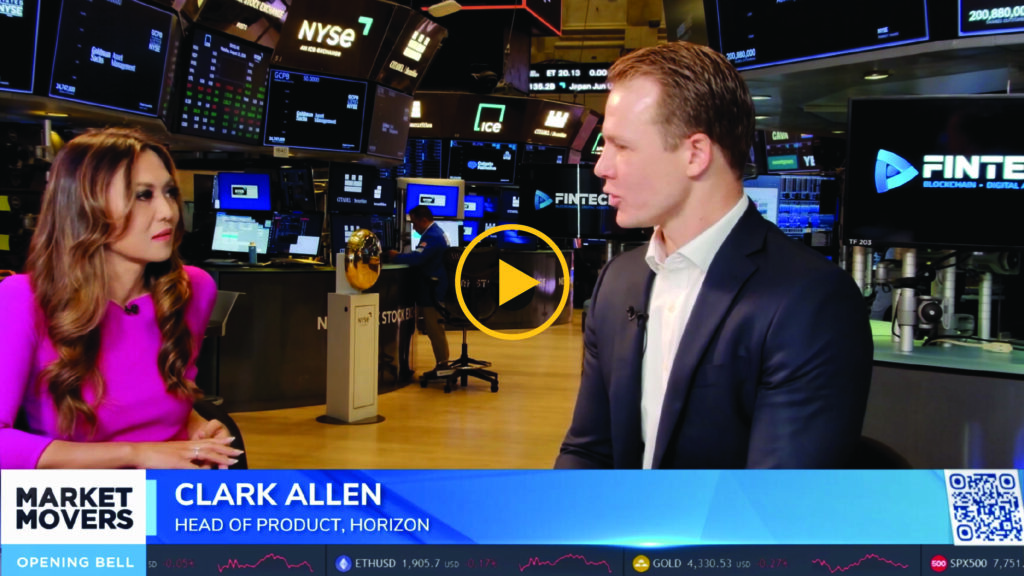
FinTech TV: Why Investors Are Turning to Active Strategies

Summary

Head of Product Clark Allen, CFA, CPA, CAIA, spoke with FinTech TV about how he thinks that amid rate uncertainty and volatility, investors should favor carefully stress-tested, outcome-oriented active strategies while remaining optimistic about strong fundamentals through 2026.

Share:

Investors should consider the investment objectives, risks, charges, and expenses carefully before investing. For a prospectus with this and other information about the fund, please visit horizonmutualfunds.com or call 866-371-2399. Please read the prospectus carefully before investing.

Performance data quoted represents past performance; past performance does not guarantee future results. The investment return and principal value of an investment will fluctuate so that an investor’s shares, when redeemed, may be worth more or less than their original cost. Current performance of the fund may be lower or higher than the performance quoted. Performance data current to the most recent month end may be obtained by calling 866-371-2399.

Investing involves risk, including potential loss of principal. There is no assurance that the fund will meet its objective.
The ability of the Fund to meet its investment objective is directly related to the allocation of the Fund’s assets. Horizon may allocate the Fund’s investments so as to under-emphasize or over-emphasize investments at the wrong times or under the wrong market conditions, in which case the Fund’s value may be adversely affected. Investments in options involve risks different from, or possibly greater than, the risks associated with investing directly in securities, including leverage risk, tracking risk, and, in the case of over-the-counter options, counterparty default risk. Small and medium capitalization companies may be more vulnerable than larger, more established organizations to adverse business or economic developments.
The value of investments in fixed income securities and securities in which the underlying investments are fixed income securities are expected to fluctuate with changes in interest rates. Typically, a rise in interest rates causes a decline in the value of the fixed income securities owned by the Fund or its underlying investments. Issuers of floating rate debt are exposed to higher interest payments in a rising rate environment. Issuers may default on interest and principal payments. Generally, securities with lower debt ratings (“junk bonds”) have greater credit risk. The Fund’s investment in U.S. government obligations may include securities issued or guaranteed as to principal and interest by the U.S. government, or its agencies or instrumentalities. Payment of principal and interest on U.S. government obligations may be backed by the full faith and credit of the United States or may be backed solely by the issuing or guaranteeing agency or instrumentality itself. There can be no assurance that the U.S. government would provide financial support to its agencies or instrumentalities (including government-sponsored enterprises) where it is not obligated to do so. In addition, U.S. government securities are not guaranteed against price movements due to changing interest rates.
ETFs are subject to additional risks that do not apply to conventional mutual funds, including the risks that the market price of an ETF’s shares may trade at a premium or discount to its net asset value, an active secondary trading market may not develop or be maintained, or trading may be halted by the exchange in which they trade, which may impact a Fund’s ability to sell its shares. Shares of any ETF are bought and sold at market price (not NAV) and are not individually redeemed from the Fund. Brokerage commissions will reduce returns.
Alpha refers to an investment’s return above or below that of a relevant benchmark after adjusting for market exposure or risk.
Duration measures a bond’s sensitivity to changes in interest rates and is generally expressed in years.
Quant refers to quantitative investing or trading, which uses mathematical models, statistical analysis, algorithms, and systematic rules to make investment decisions.
US10Y refers to the yield on the 10-year U.S. Treasury note, a benchmark interest rate commonly used to evaluate borrowing costs and broader financial conditions.
US30Y refers to the yield on the 30-year U.S. Treasury bond, which reflects long-term expectations regarding interest rates, inflation, and economic growth.
Dow Jones E-mini Futures are futures contracts linked to the Dow Jones Industrial Average that provide leveraged exposure to changes in the value of the underlying index.
NASDAQ-100 E-mini Futures are futures contracts linked to the Nasdaq-100 Index that provide leveraged exposure to changes in the value of the underlying index.
Horizon ETFs are distributed by Quasar Distributors, LLC.

Follow us on:

You are now leaving this website to go to HorizonMutualFunds.com